
My newish Guardian 5.5 came with an okay taco-style leather sheath, but I guessed before ordering the knife that the scabbard would’t do justice to the fine blade from the Washington state maker.
I was right. So I made my own.
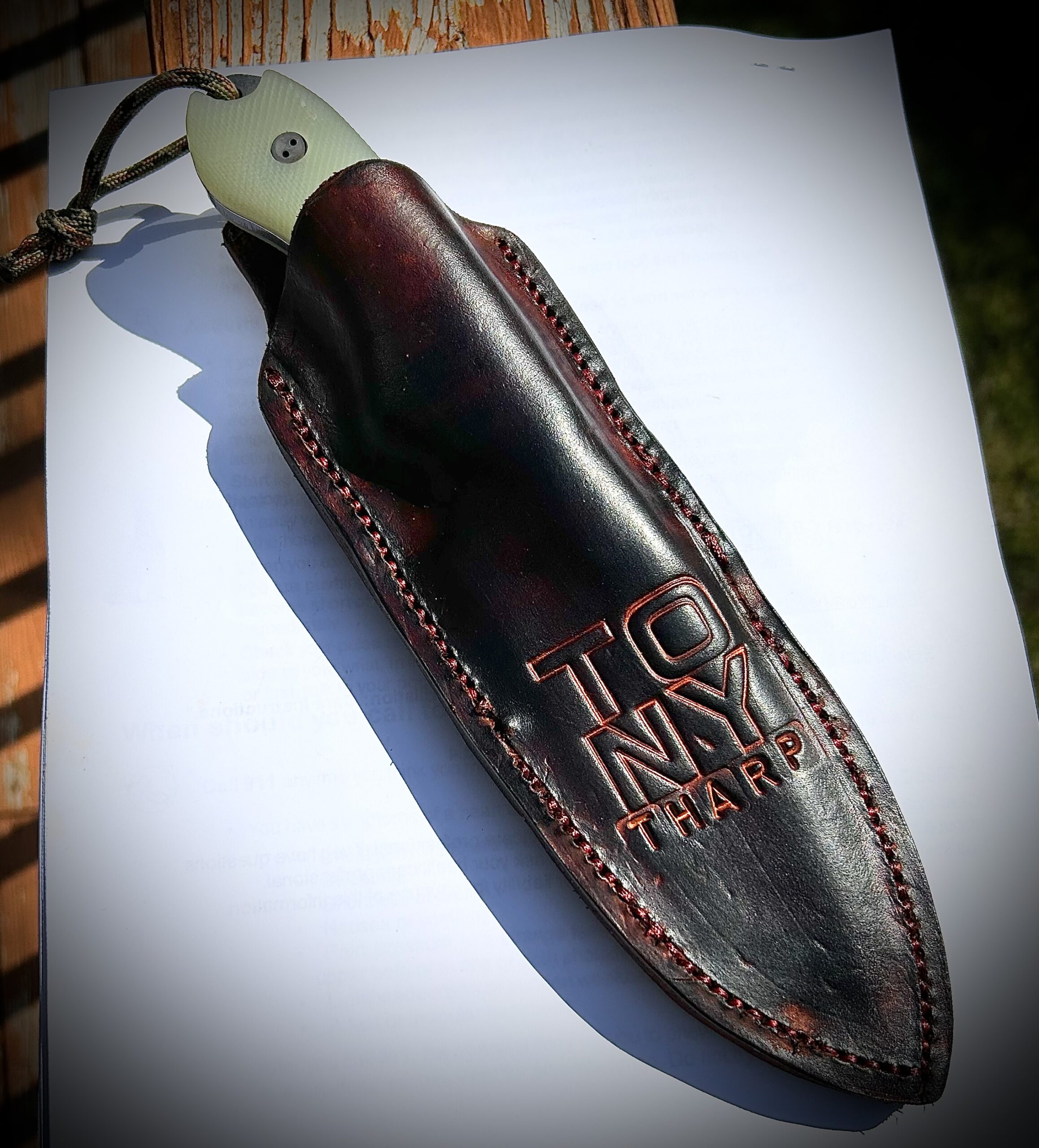
One of the early sheaths I made in a dark brown finish that I’m not especially crazy about, but I had the dye on hand. You should be able to click on the image for an expanded view.
The three sheaths I’ve made have been an improvement over the scabbard that came with the knife, I suppose, but beyond that about the best I can say for them is that they will do for now. Building them also taught me that, with more care, I will likely be able to make one I’m actually proud of.
The sheath that arrived with the knife from Bradford Knives was a “taco-style” leather sheath — a basic, fundamental one in thin and unappealling leather.
I’m not a fan of the taco style, made by folding a piece of leather over itself to fit the knife and then sewing it closed on only one side. There’s nothing wrong with a taco, and there are plenty of useful and beautiful ones around. It’s strictly a matter of what appeals to the eye.
And to my eye, the one from Bradford wasn’t one of the beautiful ones.
In making my own, I started with an 8-9 ounce vegetable tanned half-shoulder from Weaver Leather Supply, along with a few leather tools from the same company.
I wanted a pancake style sheath, which is one sewn on both sides of the knife, and thus requires melding two pieces of leather rather than simply folding it as is done in the taco style.
The half-shoulder is a big piece of leather, roughly 4 feet by 4 feet, plenty for a few tries at a knife sheath with more than enough left over for some collars for the three pups.
I made one false start. The sheath in the photo above was my second try, and the only one at that point that I went all the way with — shaping, sewing, and dyeing it.
By the way, if you know the expression that I used as the title for this piece, you can thank Shakespeare, who wrote in his “King Lear” in about 1606, “Striving to better, oft we mar what’s well” enough.
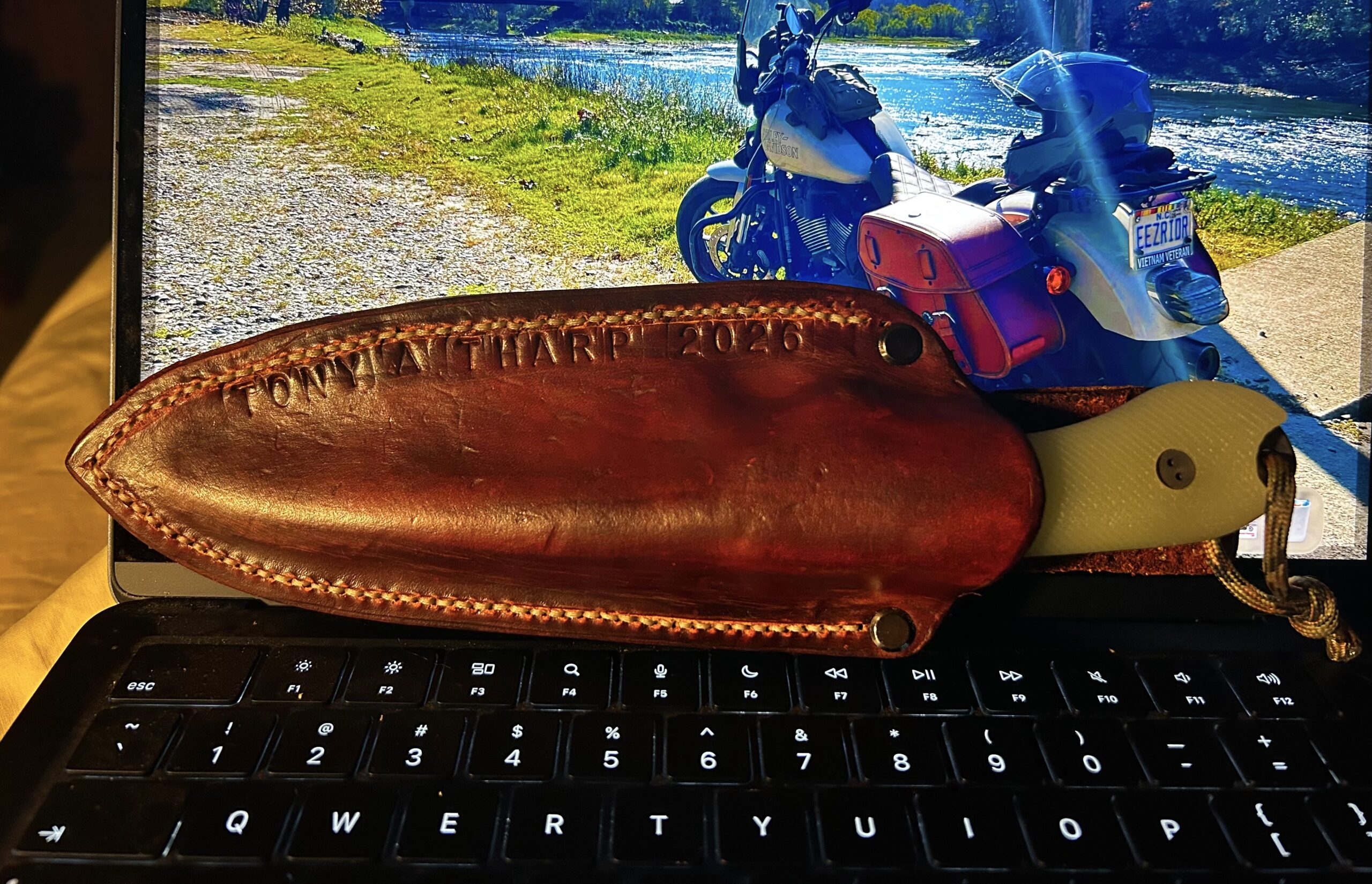
A later sheath that still shows lots of imperfections and stupid mistakes. I believe this finish is called British Tan. So far, this is a favorite. I hope I can do better. Again, you should be able to click on the image for an expanded view.
Montesquieu used the phrase, “The best is the mortal enemy of the good” in 1726, and Voltaire in 1770, borrowed an older Italian proverb, with his “Il meglio è l’inimico del bene” — The best is the enemy of the good.
Since then, the phrase has been off and running, probably even appearing in at least one episode of Beavis and Butt-Head — which, if true, almost certainly qualifies it as certified cliché.
Truth is, even without an appearance on Beavis and Butt-Head, the phrase is a cliché — worn, weathered, wrinkled and overused to the point of annoyance.
To which we plead no contest and throw ourselves on the mercy of the court.