"The hour of the American barbarian is at hand. Violence, excess, waste, mercantilism, bluff, conformism, stupidity, vulgarity, disorder." — Aimé Césaire
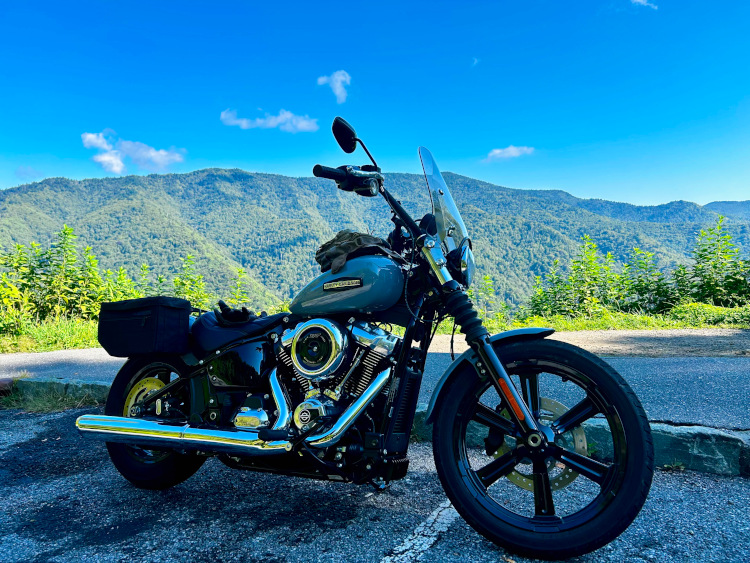
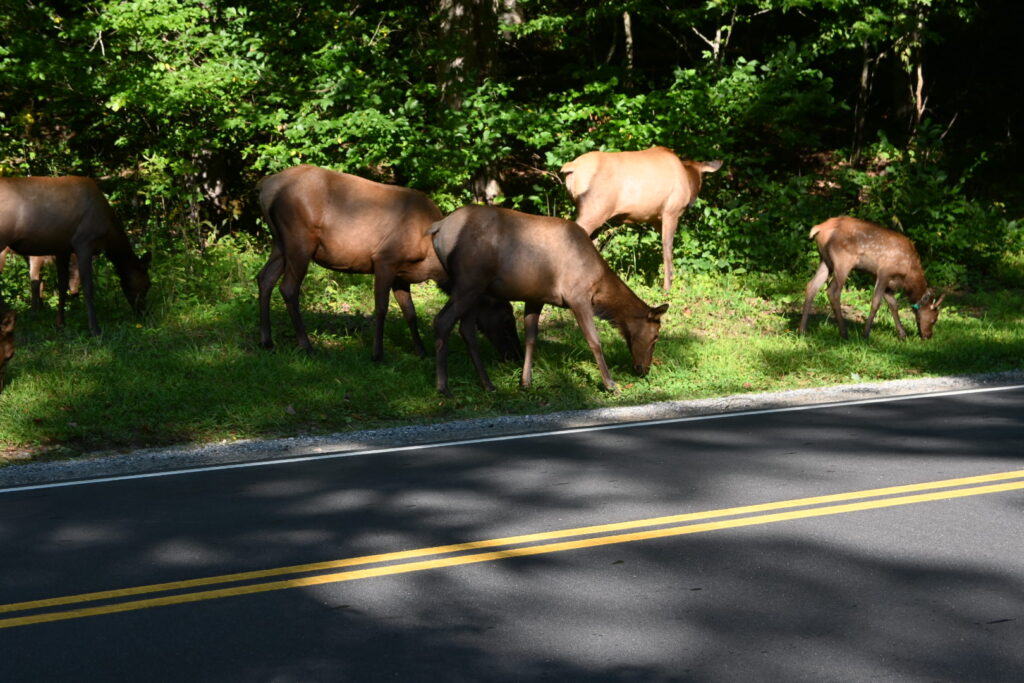
From my cabin to Cades Cove Loop in the Smoky Mountain National Park is a 270-mile round trip that takes you above the clouds, through lazy elk herds feeding on the roadside, and past more stunning views than a man can well comprehend in a single day-trip.
But if that’s what you’ve got, that’s what you make do with: A day trip, because Hazel, Phoebe and Poe would be waiting back home beside their dinner bowls.
SoI made it back to the cabin just before 1700 hours. The pups were disgusted with me but delighted to see that I survived yet another day.
I followed U.S. 74 East through Cherokee to U.S. 441 or Newfound Gap Road at the town of Cherokee. The highway runs through the Smoky Mountain National Park to Gatlinburg, but I turned west about two miles south of that tourist enclave and headed for the 11-mile one-lane drive known as Cades Cove Loop.
The loop takes you through flatter country, cleared and farmed by early settlers to the region. The area has several old homesteads, and at least three churches, an abundance of wildflowers, wetlands, pasturelands, and nice views of the landscape — but no elk, at least not on my day of touring.
At a visitor center, three women touring together from Georgia asked me to take their photo. I did. I passed one group of bikers and several lone riders, but it was mostly cars and the occasional recreational vehicle on this Tuesday. Traffic in the much-visited park is much lighter in September than in the summer months.
I went back home via Marysville and Tellico Plains, Tennessee, which made a nice loop itself.
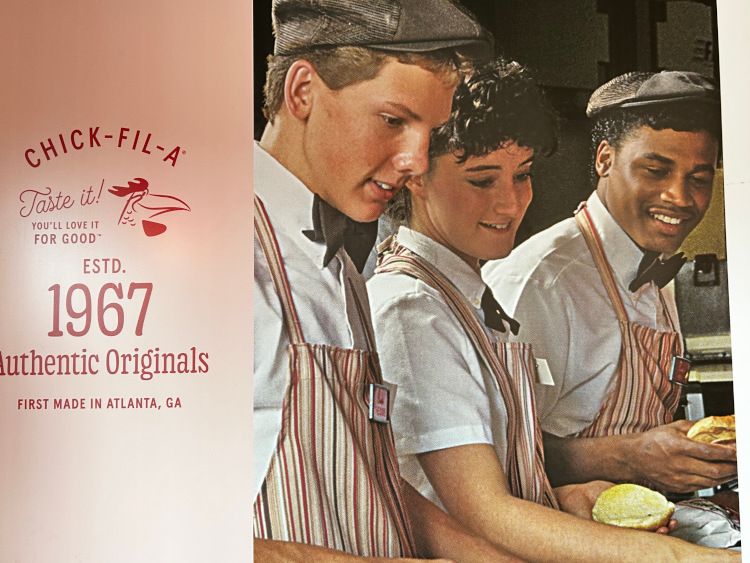
I sat down inside a Chick-fil-A for a meal of chicken strips, where a photo on the wall caught my eye. It celebrated the eatery’s founding in Atlanta, Georgia, in 1967, and shoed three smiling young cafe workers — two white and one black.
Nope, I thought. Not in 1967, Not in Atlanta, Georgia, would there be a young black man working alongside two young whites — not likely in the year of the Dixie Hill Riots, the year visiting jazz musician Les McCann sparked riots and mass protests when he was denied entry to the downtown YMCA even though he was a member. He just wasn’t the right color for Atlanta and the South in that year of racial turmoil — the year of school integration protests; the year Julian Bond, with the help of federal courts, finally gained a seat in the state’s General Assembly to which he’d been elected two years earlier.
Ah, well, I thought, what’s a little whitewashed history when the chicken is over-fried and over salty, the soft drinks are syrupey, and the skies outside are as blue as the dreams of the young, and the sun is shinning to beat the band.
The domesticated tomato may date back 7,000 or more years, but the 2026 edible variety didn’t show up in Murphy, North Carolina, until July 23 at our local farmers market. At least this was the first I had seen this season.
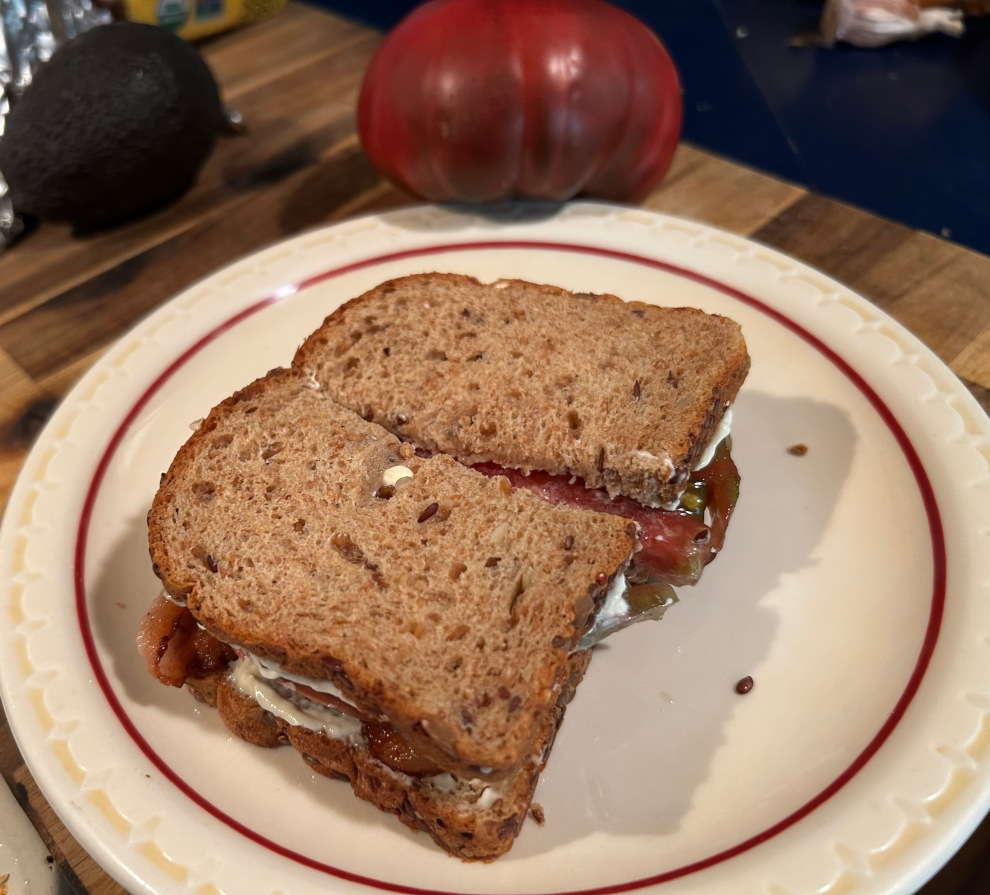
So, naturally I’ve been eating a summer’s worth of tomato sandwiches since. And every one has been worth its weight in gold.
For those who want to know, the wild ancestor of the tomato, the red-fruited Solanum pimpinellifolium, is native to Chile, Peru, and Ecuador. The exact date of domestication is unknown, but as I said earlier, about 5,000 years before the Modern Era — some 7,000 years ago.
But it’s darn odd to me that the tomato is that old and yet mankind endured another 6,900 years or so before the first mention of the tomato sandwich. That didn’t happen until 1911 when The Virginia Chronicle newspaper published the first reference to a workingman’s tomato sandwich — which the idiot paired with watermelon, according to the newspaper anyway.
Watermelon with tomato! The indignity!
The tomato itself goes with lots of things, it’s true, but I doubt any southerner has wanted to pair it with melon. Go figure.
Anyhow, for a sandwich, the only absolute requirements are good bread, Duke’s Mayonnaise, and bacon. Lettuce may not be essential, but it’s a wonderful addition to the tomato sandwich. But with the current scare over the nasty stomach ailment known as cyclosporiasis I’ve been avoiding that leafy green addition for the time being.
So salute the wonderful tomato — not the supermarket variety, which you can buy year round though rarely if ever enjoyably. Supermarket tomatoes are legendary in their tastelessness.
Murphy, my adopted hometown, is doing its best to plug the gaps in tomato appreciation and history. This coming Saturday, August. 1, the Cherokee Clay Food Alliance in conjunction with the Murphy Farmers Market bring us the 3rd annual Tomato Fest on the farm market grounds at the old train depot.
And it’s peak season for the truly edible variety. I plan to make the festival to restock my tomato supply. I hope you can.
Christian nationalists, meanwhile, are storming our shores with everything from Bible readings in public schools as policy, to the Ten Commandments wherever they can plant them, to “In God we Trust” branded onto everything but new babys’ bottoms. That has me wondering, Is the sharia-law scare a red herring?
Most of us who live in the area recognize that the popular local store known as Cherokee Guns is fond of using its advertising as the sort of in-your-face provocations that are more or less “red meat” for the MAGA base that seems to be the store’s target audience.
See the above photo for a typical example. But give the Devil his due: no right thinking person wants to see religion setting the government’s agenda.
So “right on” Cherokee Guns — except don’t stop with sharia law. Keep a careful eye on the wayward Christians as well.
Because, as a quick glance at the news will tell you, there are few worse bad ideas in this current crazy and upside-down world of ours than the increasingly wanky and far-reaching attempts to force religion into our public lives, and by doing so compel us — heathen and heaven-bound alike — to take part in the worship of today’s god of choice.
In Murphy, North Carolina, after all, “In God we Trust” is chiseled in stone on our public buildings.
And here in the Bible Belt god isn’t Allah or any other holy or supernatural entity, however generous you may wish to be with your theology. Here God is Jesus. No other deity need apply.
With every passing day there are fewer and fewer of us left who can remember the days of yore — the pre 1950s — when pushing a religion onto others in public spaces was both a violation of recognized federal law as well as being arrogant and disrespectful of cultural traditions. It was thus taboo for government at every level of our society.
The concept of a “wall of separation between Church and State” was famously championed by Thomas Jefferson in his 1802 letter to the Danbury Baptists. In that letter, Jefferson stressed the need to keep civil governance and religious practice in distinctly separate spheres.
And James Madison, the “Father of the Constitution,” drafted the First Amendment, which prohibits Congress from establishing a national religion and protects the free exercise of religion or the exercise of no religion for all citizens.
But ever since then a loud and aggrieved minority of Christian Nationalists and their equally loud and equally aggrieved sympathizers have been working overtime to undo those prohibitions or water them down — to make it seem acceptable to us to mingle religion and government — to have, in fact, a government sanctioned religion.
Too often, it’s clear, prohibitions against evangelization and proselytizing by government seem to be in increasing danger of becoming a thing of the past.
Let’s also be clear — though Cherokee Guns may have brushed past this fact — there is too often no discernible difference between Christian and sharia legality: Consider, as an example, the New Testament commandment in Luke, Chapter 19, Verse 27, where Jesus issues the order via parable, “Those enemies of mine who did not want me to be king over them — bring them here and kill them in front of me.”
Do we really want our government championing that sort of criminal brutality? Right-thinking, decent people would overwhelmingly not only say ‘no’, but ‘hell no’.
The beginning of erosion of the separation of church and state is usually traced to the Cold War when the “Red Scare” frightened our shallow public officials into adding (in 1954) “under God” to the Pledge of Allegiance and adopt (in 1956) the slogan “In God We Trust” as the national motto.
And equally shallow and misguided politicians such as Donald J. Trump are still at it.
As recently as a few days ago, when addressing a crowd at the Faith & Freedom Coalition’s annual Road to Majority conference at the Washington Hilton hotel, Trump insisted that the “(radical left) want to resume the transgender mutilation of children, they want to restart the war on Christians and churches, and as you saw with the communists elected in New York recently … they want to completely destroy the traditional American way of life.”
He described recent election winners in New York — none of whom were Republican, one can’t help but notice — as “very troubling people” and claimed without evidence (his lazy and recurring modus operandi) that they “want to destroy our country, and they hate our country and our people.”
So here we are, in 2026, well positioned to resurrect the dumbed-down days of the mid 1950s with its Red Scare and breathless fear of “communists” in every nook and cranny of our beloved but besieged nation.
It would be well for us to pause at this point and recognize that the Ten Commandments, or any other part of the Bible, Koran or whatever so-called holy books we may want to hold up for evidence of ways to live our lives are unsound foundations for both law and everyday morality.
These old books, as countless scholars have long recognized, are nothing more than the product of bronze-age tribal values. They preach a cruel form of authoritarianism, insecurity, and outdated social values, including subjugation of women, and a love of slavery.
They are consequently incompatibility in a more modern era with true ethical, humanistic, and science-based reasoning that should be the goal of us all.
It’s not too late, but it may soon be unless we stand up to the misguided religious bullies who want to take away yet another of our freedoms — the freedom to choose our own religion or to choose no religion at all.
The misguided want to return us to the days of King Charles I of early 1600 England when the state-sanctioned religion was the “high church” Anglican ceremonies and no others. Backed by the Archbishop of Canterbury, Charles I prohibited preaching outside the Anglican tradition and punished those who wouldn’t fall in line.
Disgruntled Brits fled across the ocean to a new world. Soon they were calling it the United States, and putting in place laws and customs that called for a strict separation of church and state that became part of the new nation’s founding charters.
My newish Guardian 5.5 came with an okay taco-style leather sheath, but I guessed before ordering the knife that the scabbard would’t do justice to the fine blade from the Washington state maker.
I was right. So I made my own.
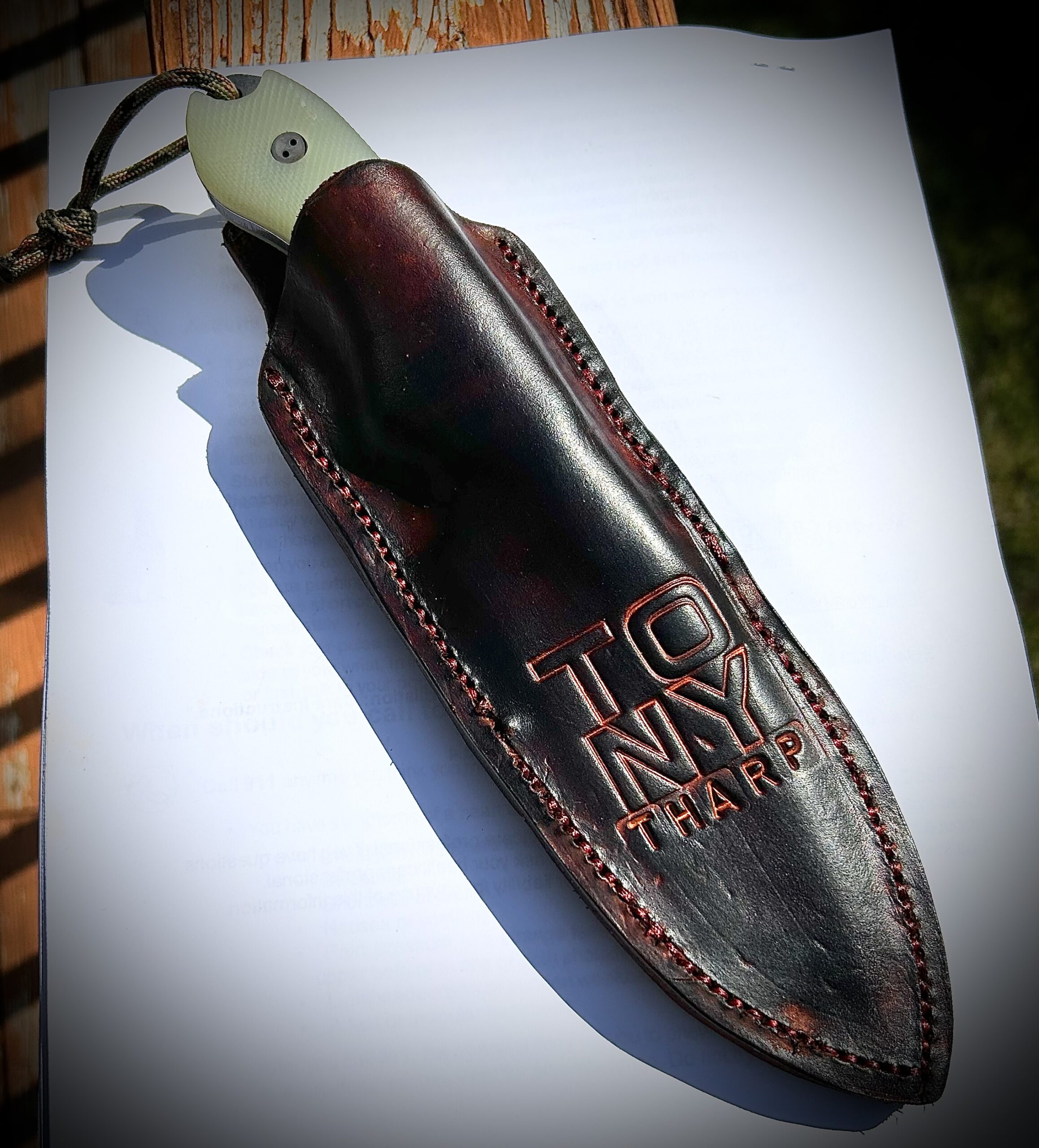
One of the early sheaths I made in a dark brown finish that I’m not especially crazy about, but I had the dye on hand. You should be able to click on the image for an expanded view.
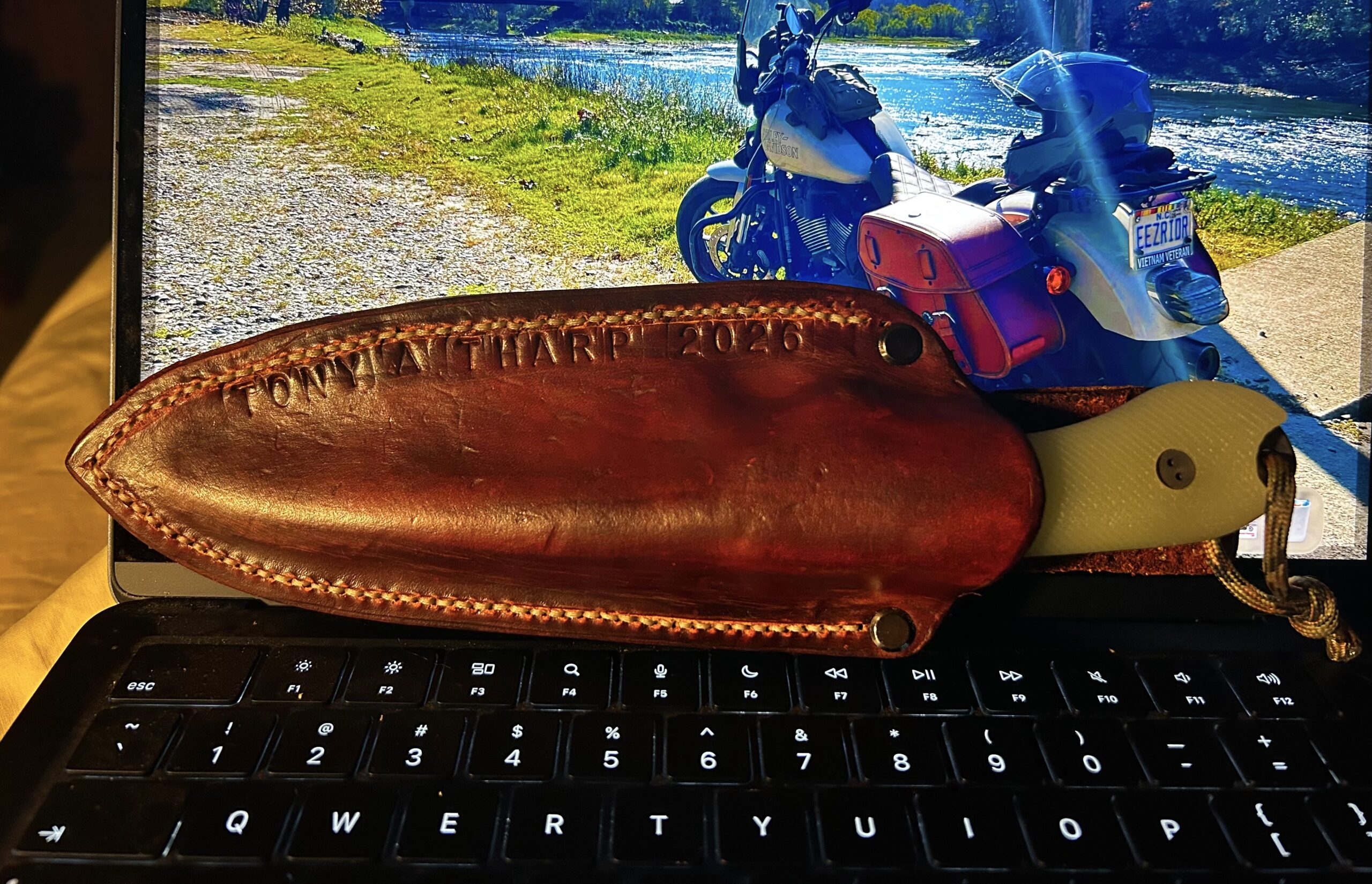
The three sheaths I’ve made have been an improvement over the scabbard that came with the knife, I suppose, but beyond that about the best I can say for them is that they will do for now. Building them also taught me that, with more care, I will likely be able to make one I’m actually proud of.
The sheath that arrived with the knife from Bradford Knives was a “taco-style” leather sheath — a basic, fundamental one in thin and unappealling leather.
I’m not a fan of the taco style, made by folding a piece of leather over itself to fit the knife and then sewing it closed on only one side. There’s nothing wrong with a taco, and there are plenty of useful and beautiful ones around. It’s strictly a matter of what appeals to the eye.
And to my eye, the one from Bradford wasn’t one of the beautiful ones.
In making my own, I started with an 8-9 ounce vegetable tanned half-shoulder from Weaver Leather Supply, along with a few leather tools from the same company.
I wanted a pancake style sheath, which is one sewn on both sides of the knife, and thus requires melding two pieces of leather rather than simply folding it as is done in the taco style.
The half-shoulder is a big piece of leather, roughly 4 feet by 4 feet, plenty for a few tries at a knife sheath with more than enough left over for some collars for the three pups.
I made one false start. The sheath in the photo above was my second try, and the only one at that point that I went all the way with — shaping, sewing, and dyeing it.
By the way, if you know the expression that I used as the title for this piece, you can thank Shakespeare, who wrote in his “King Lear” in about 1606, “Striving to better, oft we mar what’s well” enough.
A later sheath that still shows lots of imperfections and stupid mistakes. I believe this finish is called British Tan. So far, this is a favorite. I hope I can do better. Again, you should be able to click on the image for an expanded view.
Montesquieu used the phrase, “The best is the mortal enemy of the good” in 1726, and Voltaire in 1770, borrowed an older Italian proverb, with his “Il meglio è l’inimico del bene” — The best is the enemy of the good.
Since then, the phrase has been off and running, probably even appearing in at least one episode of Beavis and Butt-Head — which, if true, almost certainly qualifies it as certified cliché.
Truth is, even without an appearance on Beavis and Butt-Head, the phrase is a cliché — worn, weathered, wrinkled and overused to the point of annoyance.
To which we plead no contest and throw ourselves on the mercy of the court.
Five New York newspapers gave birth to The Associated Press in 1846 when they pooled their resources to share the cost of reporting on the Mexican-American War.
And for the 180 years since then, the wire service has served newspapers all over the world.
No more, at least not as a core part of its business.
Today it announced buyout offers it has made to more than 100 of its journalists and said it is pivoting away from newspapers and shifting to visual reports, and will be trying to develop new revenue sources through companies investing in artificial intelligence.
It’s a bow to the realities of today’s media landscape. Newspapers now make up just 10 percent of the AP’s income.
But even in today’s news world, the announcement is something of a stunner: Journalists of my generation grew up on the AP, where the click, clatter and chiming “ding” of an Associated Press teletype was the background hum of our newsrooms.
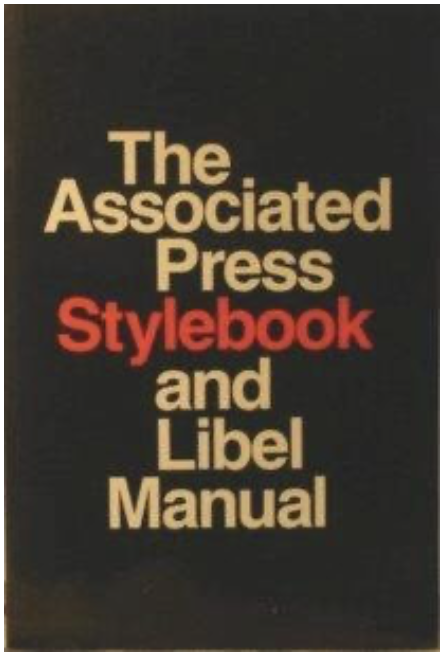
“The Associated Press Stylebook and Libel Manual” was one of the first things an aspiring newspaperman bought — usually with his first paycheck if he or she didn’t already own a copy.
“We’re not a newspaper company and we haven’t been for quite some time,” Julie Pace, executive editor and senior vice president of the AP, told the AP’s own David Bauder.
Gannett and McClatchy, two of the U.S.’s largest newspaper companies, stopped publishing AP wire content in 2024, contributing to a 25 percent decline in The Associated Press’ newspaper revenue in the past four years.
According to Bauder’s article, the AP had also learned that Lee Enterprises, yet another large newspaper publisher and AP client, was looking for a way out of a contract that is set to expire at the end of this year.
Pace told Bauder that whether or not the company conducts layoffs will depend on how many people take the buyout.
Still, Pace said, “The AP is not in trouble…We’re making these changes from a position of strength but we’re doing so now to recognize our changing customer base.”
The AP will be upping its video teams, as well as adding journalists to beats “on topics of known customer interest.” It will also still have journalists in all 50 states.
Lately, the AP has been looking to tech companies for revenue (and says its revenue from such deals has grown by 200 percent over the last four years. It’s made deals with Google and OpenAI, and in March announced a deal to provide election data to the prediction market Kalshi. Elections in particular are a big money-maker for the AP; last year ABC, CBS, NBC, and CNN all signed up for its service providing election data.
The AP News Guild, the union representing AP staff, has said 120 people were offered buyouts. The union also said that the AP ignored a union request to bargain over artificial intelligence.
“AP continues to get rid of experienced staff and flirt with artificial intelligence” the union said in its statement, “ignoring the opportunity to differentiate AP stories as ones that are and always will be created by human journalists,” the Guild said.
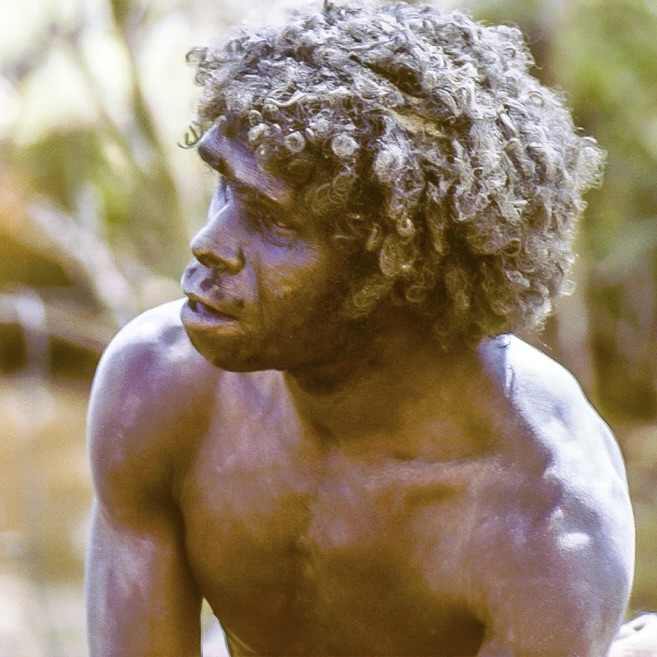
The man we know today as Turkana Boy was almost certainly smiling when he picked up his new stone knife, gently rubbed his finger along the freshly flinted edge, and uttered a satisfied, “Ah, yea,” — or its equivalent in the lingo of Homo erectus.
We humans, beginning with our early ancestors, have been using knives for at least 1.5 million years, and you can be assured they were as much a joy to us back then as they are today.
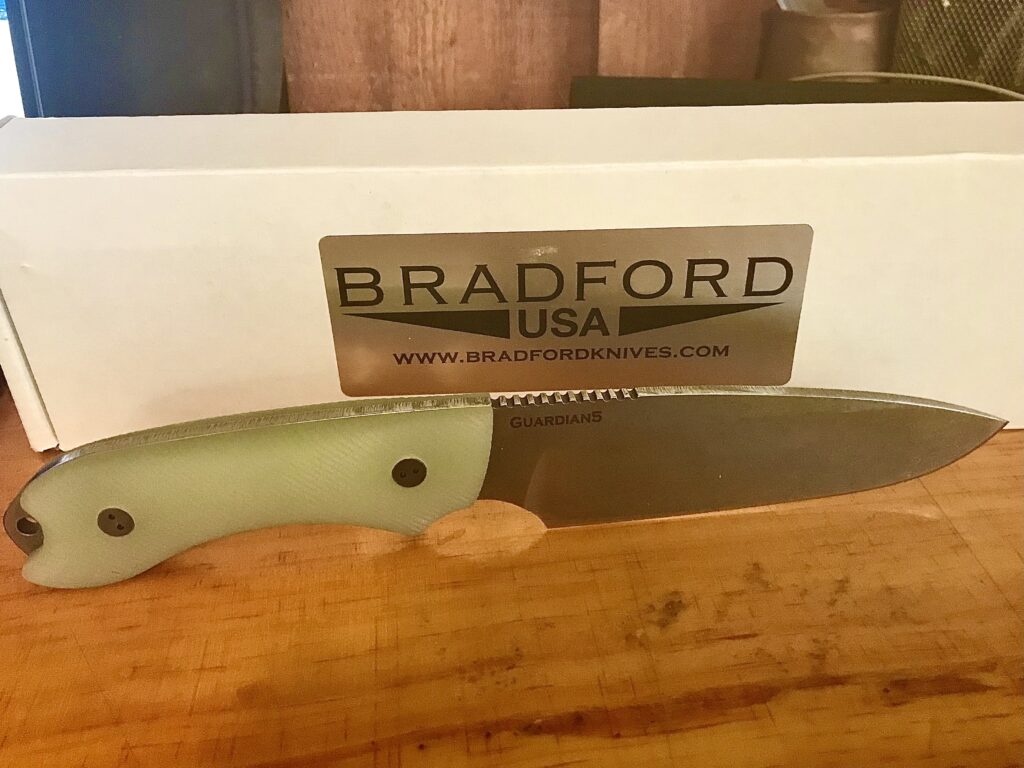
The Guardian 5 from Bradford knives.
A joy, a necessity, and all but indispensable first-tool for humankind that has never lost its intrinsic appeal.
That’s because a good knife is as useful and necessary today as it was when Turkana Boy and his family were hunting the banks of the Nariokotome River in northwest Kenya during the Early Pleistocene epoch.
To hold a sharp, well-made knife in your hands is to slip through the gates of space and time and join the caravan of pre-historic travelers setting out from their African base on an ages-long, dangerous, and uncertain journey to colonize the world.
The knife was the essential tool in making that journey possible.
Turkana Boy
While the function of a knife is the same today as it was when Turkana Boy sliced a serving of antelope from the animal roasting above his family campfire, the material they’re made from has come a ways.
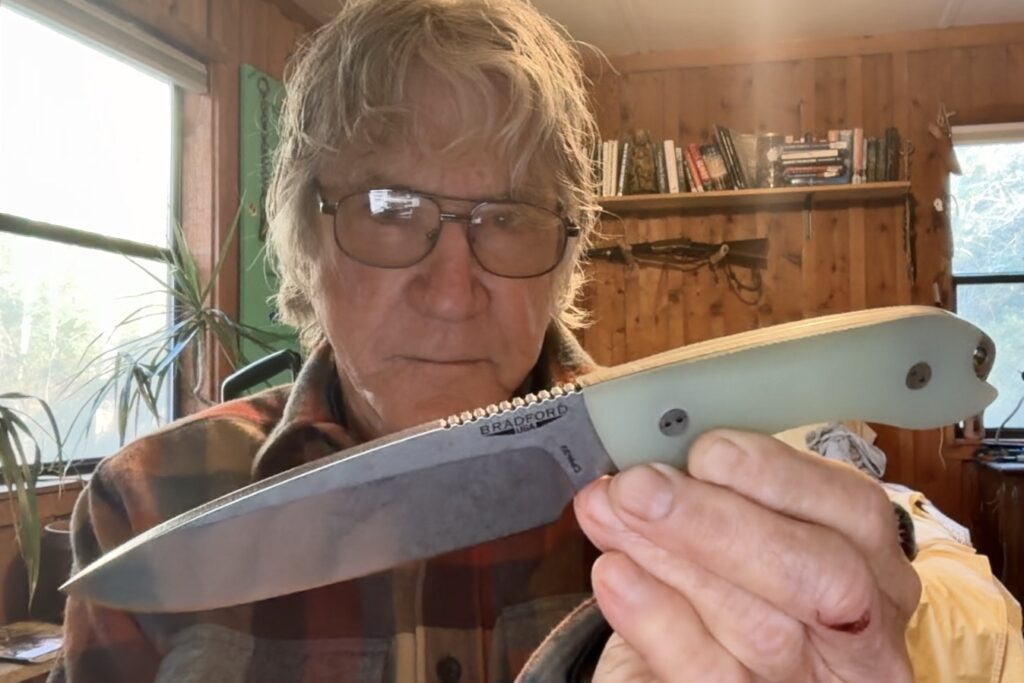
Take the Guardian 5 shown in the photo above: it’s fashioned from a high-tech steel manufactured by Crucible Industries using a sintered proprietary process known as Crucible Particle Metallurgy which — to greatly simplify the undertaking — atomizes molten alloy into fine powder that is then hot pressed into sheets that are just about ideal for making exceptionally hard and super-sharp knives.
There’s a vast difference between today’s steels and yesteryear’s D2 tool steel from which most of our old knives were made. That said, D2 still makes a better than passable knife, though short of what you get with CPM-3V, Magnacut, Elmax, Cruwear or some of the other more refined and more pure steels.
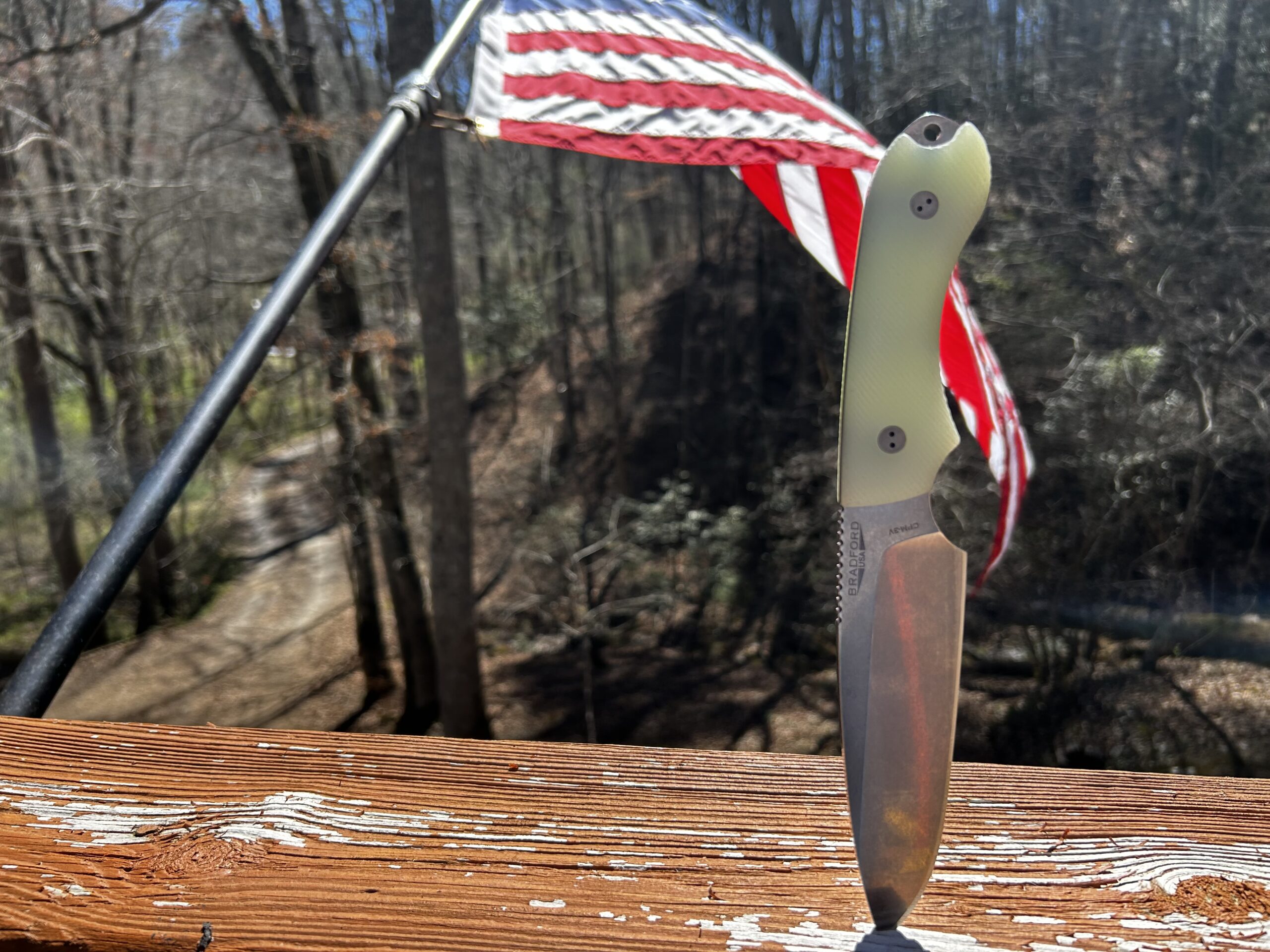
Another view of the Guardian 5 from Bradford knives.
The newer steels vastly reduce impurities and non-metallic goop that create weak points in a blade — unwanted hitchhikers such as sulfur, nitrogen, phosphorus and junk metals like tin or lead. With that detritus gone or minimized you’re left with a steel that has increased edge retention, more toughness and greater corrosion resistance.
The Guardian 5 blade, for those who may wish to know, is finished in what Bradford calls “stonewash;” the blade is ground to a sabre edge. The handle is made of G-10, a high-pressure fiberglass laminate of cloth and epoxy resin. It’s exceptionally strong, moisture-resistant and lightweight. The light green finish on the handles on my model is called “ghost.”
Bradford Guardian 5
G-10 is also low- to zero- maintenance, making it a popular choice for outdoor and heavy-use knives.
You can get the Guardian in other configurations and lengths, from a 3-inch to a 6-inch blade, I believe, along with other blade finishes and a choice of several handle finishes. All ship with a sheath — leather or nylon. Take a look at the company website.
Bradford USA is located in Kent, in Washington State. You won’t go wrong ordering your next knife from them.