"The hour of the American barbarian is at hand. Violence, excess, waste, mercantilism, bluff, conformism, stupidity, vulgarity, disorder." — Aimé Césaire
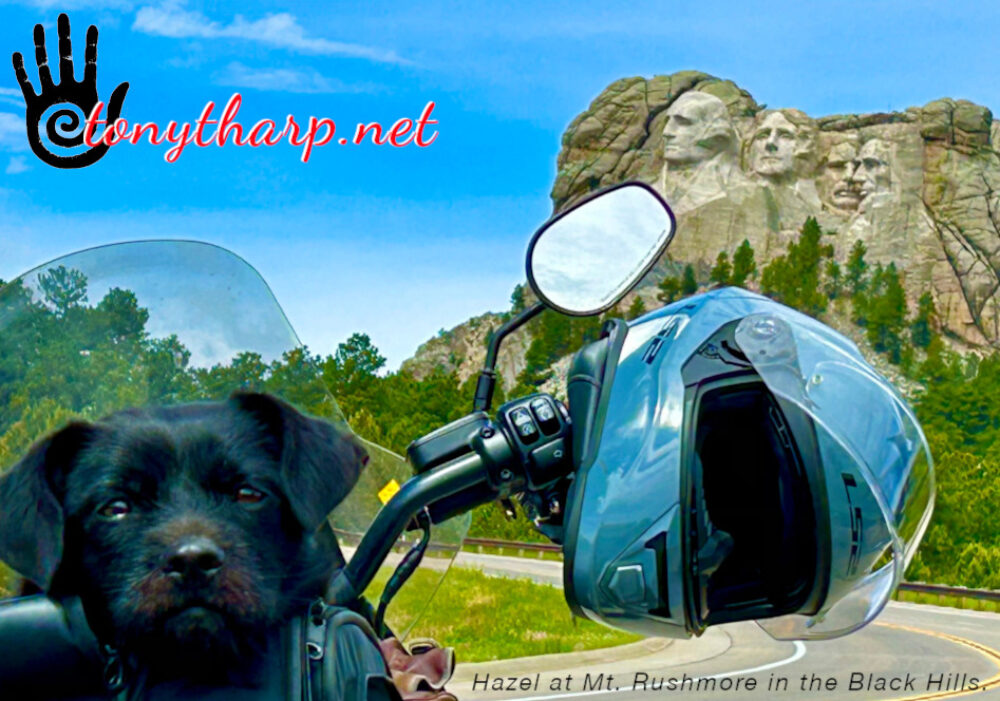
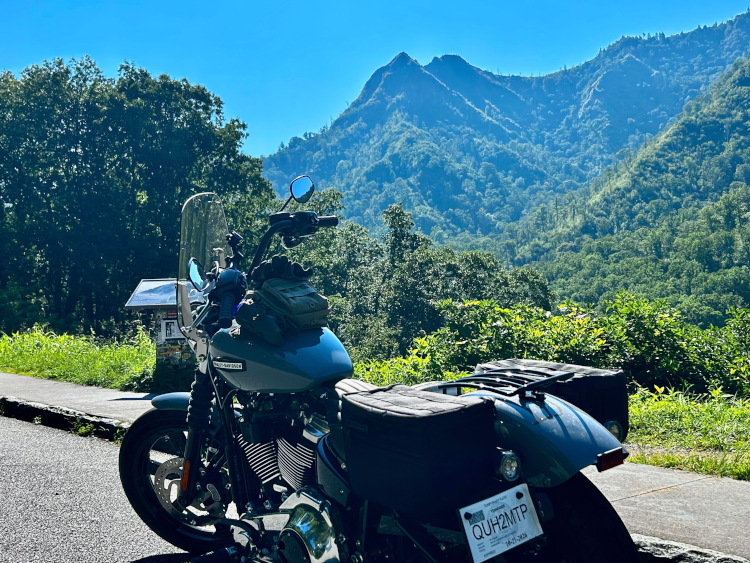
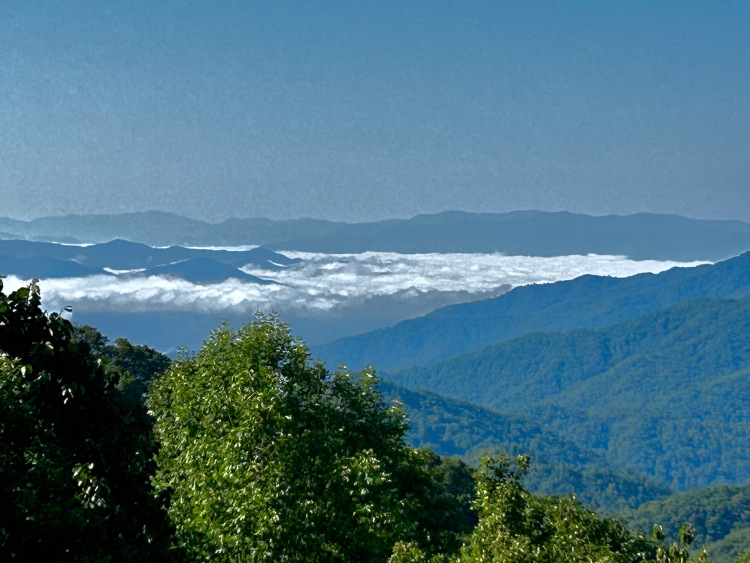
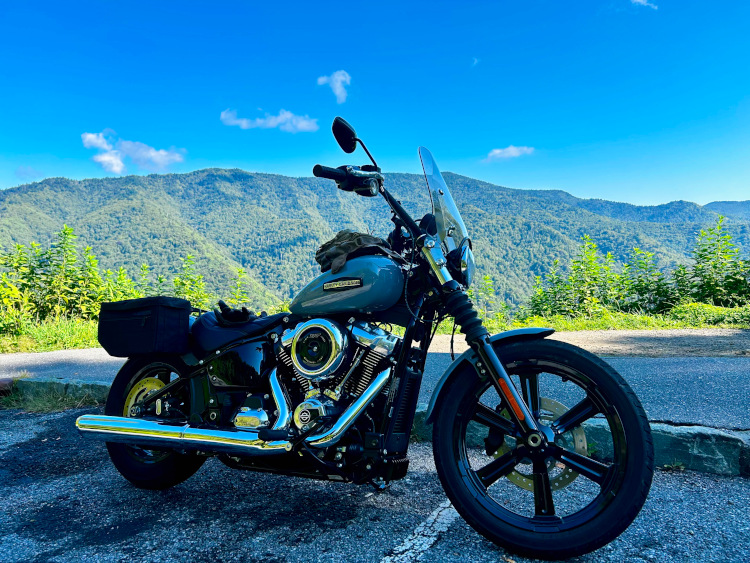
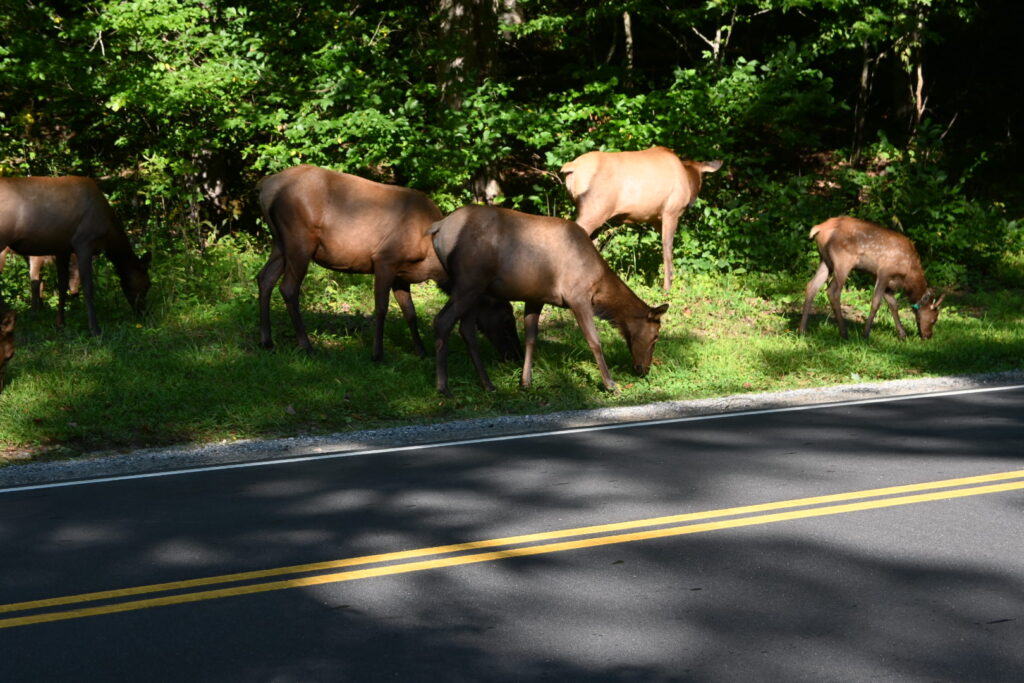
From my cabin to Cades Cove Loop in the Smoky Mountain National Park is a 270-mile round trip that takes you above the clouds, through lazy elk herds feeding on the roadside, and past more stunning views than a man can well comprehend in a single day-trip.
But if that’s what you’ve got, that’s what you make do with: A day trip, because Hazel, Phoebe and Poe would be waiting back home beside their dinner bowls.
SoI made it back to the cabin just before 1700 hours. The pups were disgusted with me but delighted to see that I survived yet another day.
I followed U.S. 74 East through Cherokee to U.S. 441 or Newfound Gap Road at the town of Cherokee. The highway runs through the Smoky Mountain National Park to Gatlinburg, but I turned west about two miles south of that tourist enclave and headed for the 11-mile one-lane drive known as Cades Cove Loop.
The loop takes you through flatter country, cleared and farmed by early settlers to the region. The area has several old homesteads, and at least three churches, an abundance of wildflowers, wetlands, pasturelands, and nice views of the landscape — but no elk, at least not on my day of touring.
At a visitor center, three women touring together from Georgia asked me to take their photo. I did. I passed one group of bikers and several lone riders, but it was mostly cars and the occasional recreational vehicle on this Tuesday. Traffic in the much-visited park is much lighter in September than in the summer months.
I went back home via Marysville and Tellico Plains, Tennessee, which made a nice loop itself.
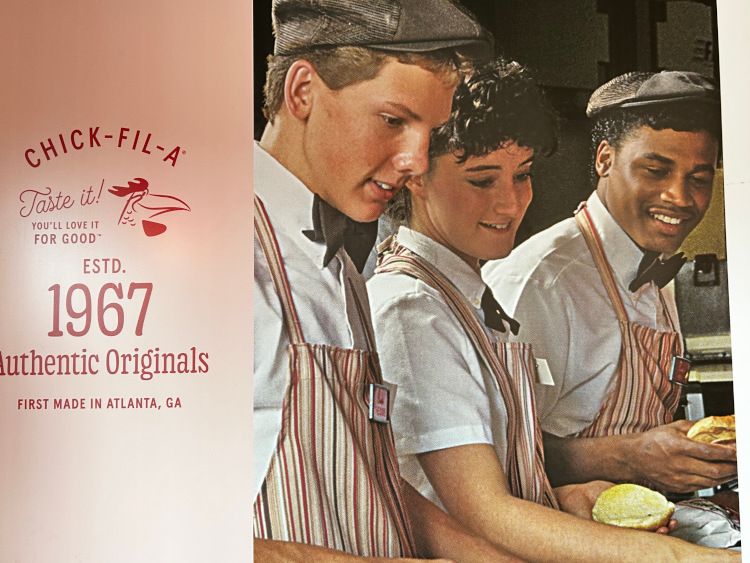
I sat down inside a Chick-fil-A for a meal of chicken strips, where a photo on the wall caught my eye. It celebrated the eatery’s founding in Atlanta, Georgia, in 1967, and shoed three smiling young cafe workers — two white and one black.
Nope, I thought. Not in 1967, Not in Atlanta, Georgia, would there be a young black man working alongside two young whites — not likely in the year of the Dixie Hill Riots, the year visiting jazz musician Les McCann sparked riots and mass protests when he was denied entry to the downtown YMCA even though he was a member. He just wasn’t the right color for Atlanta and the South in that year of racial turmoil — the year of school integration protests; the year Julian Bond, with the help of federal courts, finally gained a seat in the state’s General Assembly to which he’d been elected two years earlier.
Ah, well, I thought, what’s a little whitewashed history when the chicken is over-fried and over salty, the soft drinks are syrupey, and the skies outside are as blue as the dreams of the young, and the sun is shinning to beat the band.
It’s hard to know how many of us citizens are monitoring the mess oozing from the ground in Ohio, where toxic waste water from fracking is bubbling out of the soil in dozens of places and is all but certain to show up one day in the drinking water of historic Marietta, Ohio, and other communities.
The radioactive mess should surprise no one. Ohio state officials have in the past few years approved more than 240 “injection wells” for the disposal of the waste oil and gas that are byproducts of fracking to mine the earth for natural gas.
By comparison, there are just 19 such injection wells in Pennsylvania, and a few dozen in West Virginia, both of which border Ohio.
State officials, like officials everywhere else, assured citizens the injection wells would safely entomb the water for ever.
That was, of course, a lie.
Beyond the toxic leaks oozing in yards, state forest, and farm fields are hundreds of millions of gallons of radioactive fracking wastewater buried with the state’s blessings beneath the feet of Ohioans.
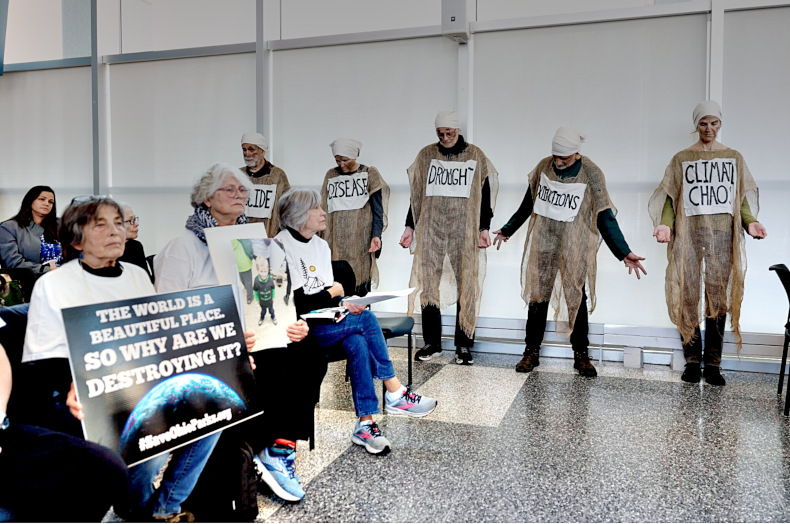
COLUMBUS, OH — FEBRUARY 26: Protesters from Save Ohio Parks during the Ohio Oil and Gas Land Management Commission meeting to pick the winning bids for drilling under a state park and two wildlife areas, February 26, 2024, at the Ohio Dept. of Public Safety, Charles D. Shipley Building Atrium in Columbus, Ohio.
For years, it has arrived in a caravan of tanker trucks that come night and day to deposit the toxic brine in injection wells that pump it thousands of feet underground, where it is supposed to stay forever.
Except, oops. The poison brine is spurting to the surface, and locals fear it could soon contaminate the drinking water source for 32,000 people. “It would destroy the city,” said Susan Vessels, president of the Marietta City Council. “Once the damage is done, it cannot be undone.”
Vessels claims — though I’m absolutely not convinced — that residents and local officials were for years “completely unaware” of their place at the heart of an interstate marketplace for toxic waste. They’ve come to realize, she said, that their corner of Ohio has become a major destination for fracking brine.
What Vessels should have said is that she and others around Marietta were willingly blind to the destruction of Mother Earth. The photo of protestors at an Ohio fracking meeting comes from a February 2024 article, and there are news reports earlier than that.
This ecological nightmare didn’t come out of no where. It came with the approval of state and the silence of far too man local officials and citizens.
Valerie Turner lays lead guitar, handles lead vocals, and specializes in intricate Piedmont-style ragtime fingerpicking, while her husband and bandmate Benedict (Ben) Turner provides traditional roots percussion using the washboard, bones, harmonica, and harmony vocals. The two serve as cultural historians and educators preserving early African-American country blues.
Christian nationalists, meanwhile, are storming our shores with everything from Bible readings in public schools as policy, to the Ten Commandments wherever they can plant them, to “In God we Trust” branded onto everything but new babys’ bottoms. That has me wondering, Is the sharia-law scare a red herring?
Most of us who live in the area recognize that the popular local store known as Cherokee Guns is fond of using its advertising as the sort of in-your-face provocations that are more or less “red meat” for the MAGA base that seems to be the store’s target audience.
See the above photo for a typical example. But give the Devil his due: no right thinking person wants to see religion setting the government’s agenda.
So “right on” Cherokee Guns — except don’t stop with sharia law. Keep a careful eye on the wayward Christians as well.
Because, as a quick glance at the news will tell you, there are few worse bad ideas in this current crazy and upside-down world of ours than the increasingly wanky and far-reaching attempts to force religion into our public lives, and by doing so compel us — heathen and heaven-bound alike — to take part in the worship of today’s god of choice.
In Murphy, North Carolina, after all, “In God we Trust” is chiseled in stone on our public buildings.
And here in the Bible Belt god isn’t Allah or any other holy or supernatural entity, however generous you may wish to be with your theology. Here God is Jesus. No other deity need apply.
With every passing day there are fewer and fewer of us left who can remember the days of yore — the pre 1950s — when pushing a religion onto others in public spaces was both a violation of recognized federal law as well as being arrogant and disrespectful of cultural traditions. It was thus taboo for government at every level of our society.
The concept of a “wall of separation between Church and State” was famously championed by Thomas Jefferson in his 1802 letter to the Danbury Baptists. In that letter, Jefferson stressed the need to keep civil governance and religious practice in distinctly separate spheres.
And James Madison, the “Father of the Constitution,” drafted the First Amendment, which prohibits Congress from establishing a national religion and protects the free exercise of religion or the exercise of no religion for all citizens.
But ever since then a loud and aggrieved minority of Christian Nationalists and their equally loud and equally aggrieved sympathizers have been working overtime to undo those prohibitions or water them down — to make it seem acceptable to us to mingle religion and government — to have, in fact, a government sanctioned religion.
Too often, it’s clear, prohibitions against evangelization and proselytizing by government seem to be in increasing danger of becoming a thing of the past.
Let’s also be clear — though Cherokee Guns may have brushed past this fact — there is too often no discernible difference between Christian and sharia legality: Consider, as an example, the New Testament commandment in Luke, Chapter 19, Verse 27, where Jesus issues the order via parable, “Those enemies of mine who did not want me to be king over them — bring them here and kill them in front of me.”
Do we really want our government championing that sort of criminal brutality? Right-thinking, decent people would overwhelmingly not only say ‘no’, but ‘hell no’.
The beginning of erosion of the separation of church and state is usually traced to the Cold War when the “Red Scare” frightened our shallow public officials into adding (in 1954) “under God” to the Pledge of Allegiance and adopt (in 1956) the slogan “In God We Trust” as the national motto.
And equally shallow and misguided politicians such as Donald J. Trump are still at it.
As recently as a few days ago, when addressing a crowd at the Faith & Freedom Coalition’s annual Road to Majority conference at the Washington Hilton hotel, Trump insisted that the “(radical left) want to resume the transgender mutilation of children, they want to restart the war on Christians and churches, and as you saw with the communists elected in New York recently … they want to completely destroy the traditional American way of life.”
He described recent election winners in New York — none of whom were Republican, one can’t help but notice — as “very troubling people” and claimed without evidence (his lazy and recurring modus operandi) that they “want to destroy our country, and they hate our country and our people.”
So here we are, in 2026, well positioned to resurrect the dumbed-down days of the mid 1950s with its Red Scare and breathless fear of “communists” in every nook and cranny of our beloved but besieged nation.
It would be well for us to pause at this point and recognize that the Ten Commandments, or any other part of the Bible, Koran or whatever so-called holy books we may want to hold up for evidence of ways to live our lives are unsound foundations for both law and everyday morality.
These old books, as countless scholars have long recognized, are nothing more than the product of bronze-age tribal values. They preach a cruel form of authoritarianism, insecurity, and outdated social values, including subjugation of women, and a love of slavery.
They are consequently incompatibility in a more modern era with true ethical, humanistic, and science-based reasoning that should be the goal of us all.
It’s not too late, but it may soon be unless we stand up to the misguided religious bullies who want to take away yet another of our freedoms — the freedom to choose our own religion or to choose no religion at all.
The misguided want to return us to the days of King Charles I of early 1600 England when the state-sanctioned religion was the “high church” Anglican ceremonies and no others. Backed by the Archbishop of Canterbury, Charles I prohibited preaching outside the Anglican tradition and punished those who wouldn’t fall in line.
Disgruntled Brits fled across the ocean to a new world. Soon they were calling it the United States, and putting in place laws and customs that called for a strict separation of church and state that became part of the new nation’s founding charters.
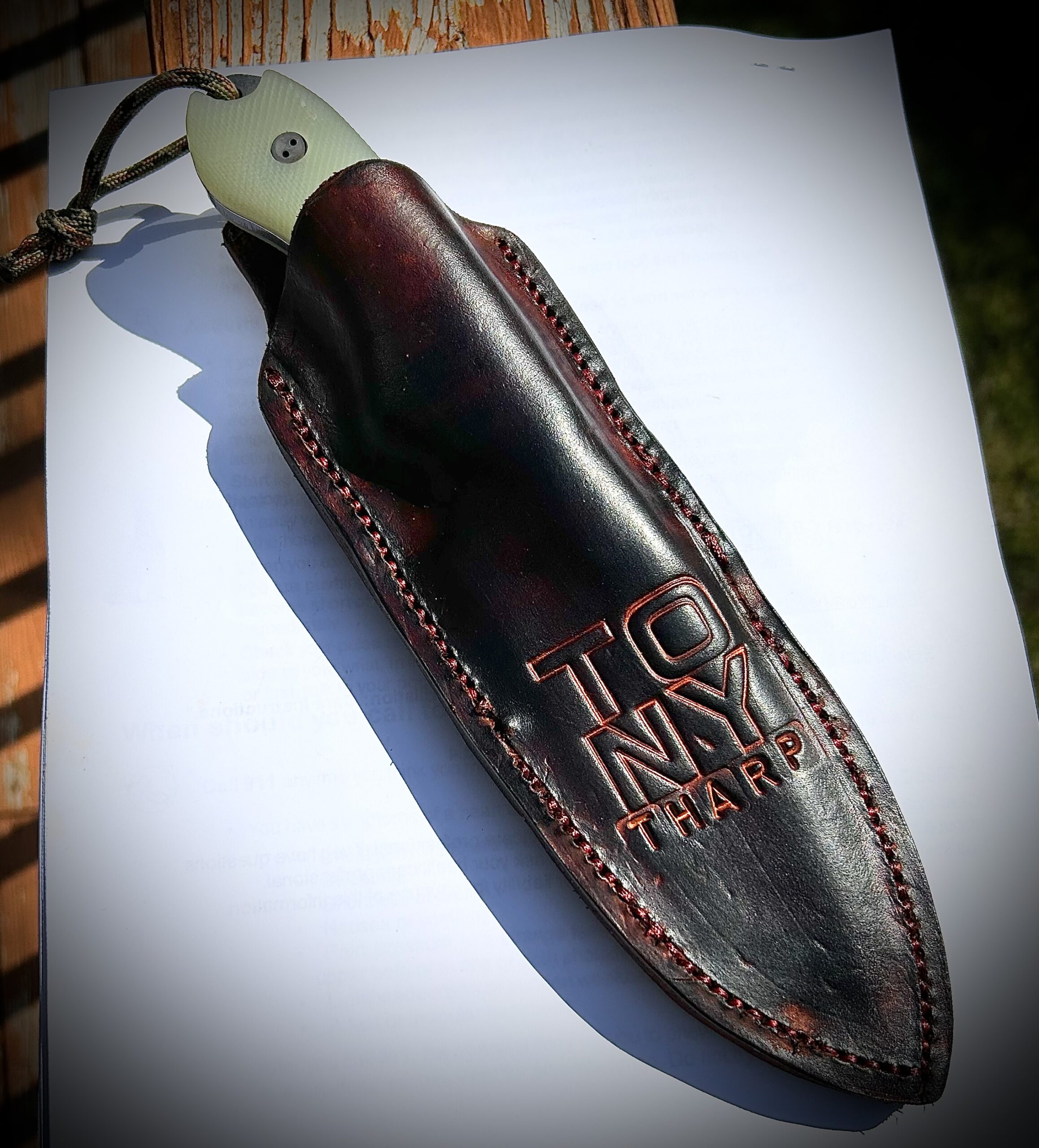
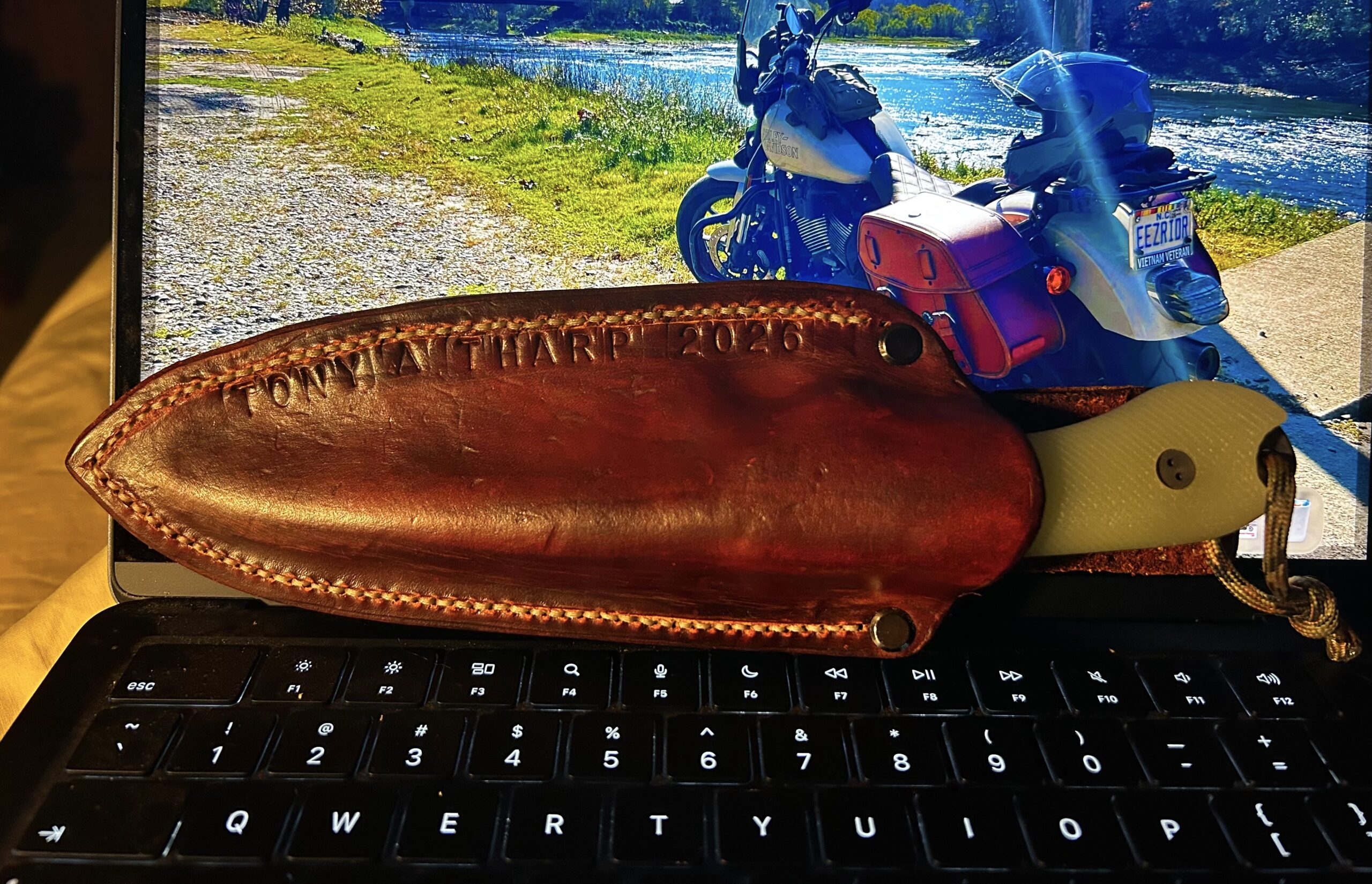
My newish Guardian 5.5 came with an okay taco-style leather sheath, but I guessed before ordering the knife that the scabbard would’t do justice to the fine blade from the Washington state maker.
I was right. So I made my own.
One of the early sheaths I made in a dark brown finish that I’m not especially crazy about, but I had the dye on hand. You should be able to click on the image for an expanded view.
The three sheaths I’ve made have been an improvement over the scabbard that came with the knife, I suppose, but beyond that about the best I can say for them is that they will do for now. Building them also taught me that, with more care, I will likely be able to make one I’m actually proud of.
The sheath that arrived with the knife from Bradford Knives was a “taco-style” leather sheath — a basic, fundamental one in thin and unappealling leather.
I’m not a fan of the taco style, made by folding a piece of leather over itself to fit the knife and then sewing it closed on only one side. There’s nothing wrong with a taco, and there are plenty of useful and beautiful ones around. It’s strictly a matter of what appeals to the eye.
And to my eye, the one from Bradford wasn’t one of the beautiful ones.
In making my own, I started with an 8-9 ounce vegetable tanned half-shoulder from Weaver Leather Supply, along with a few leather tools from the same company.
I wanted a pancake style sheath, which is one sewn on both sides of the knife, and thus requires melding two pieces of leather rather than simply folding it as is done in the taco style.
The half-shoulder is a big piece of leather, roughly 4 feet by 4 feet, plenty for a few tries at a knife sheath with more than enough left over for some collars for the three pups.
I made one false start. The sheath in the photo above was my second try, and the only one at that point that I went all the way with — shaping, sewing, and dyeing it.
By the way, if you know the expression that I used as the title for this piece, you can thank Shakespeare, who wrote in his “King Lear” in about 1606, “Striving to better, oft we mar what’s well” enough.
A later sheath that still shows lots of imperfections and stupid mistakes. I believe this finish is called British Tan. So far, this is a favorite. I hope I can do better. Again, you should be able to click on the image for an expanded view.
Montesquieu used the phrase, “The best is the mortal enemy of the good” in 1726, and Voltaire in 1770, borrowed an older Italian proverb, with his “Il meglio è l’inimico del bene” — The best is the enemy of the good.
Since then, the phrase has been off and running, probably even appearing in at least one episode of Beavis and Butt-Head — which, if true, almost certainly qualifies it as certified cliché.
Truth is, even without an appearance on Beavis and Butt-Head, the phrase is a cliché — worn, weathered, wrinkled and overused to the point of annoyance.
To which we plead no contest and throw ourselves on the mercy of the court.
Curves, tunnels, steep ascents, unnerving drops down the mountain when the weight of the train threatens to overrun the engine and send the whole enterprise cascading down into ruin.
Life is like that.
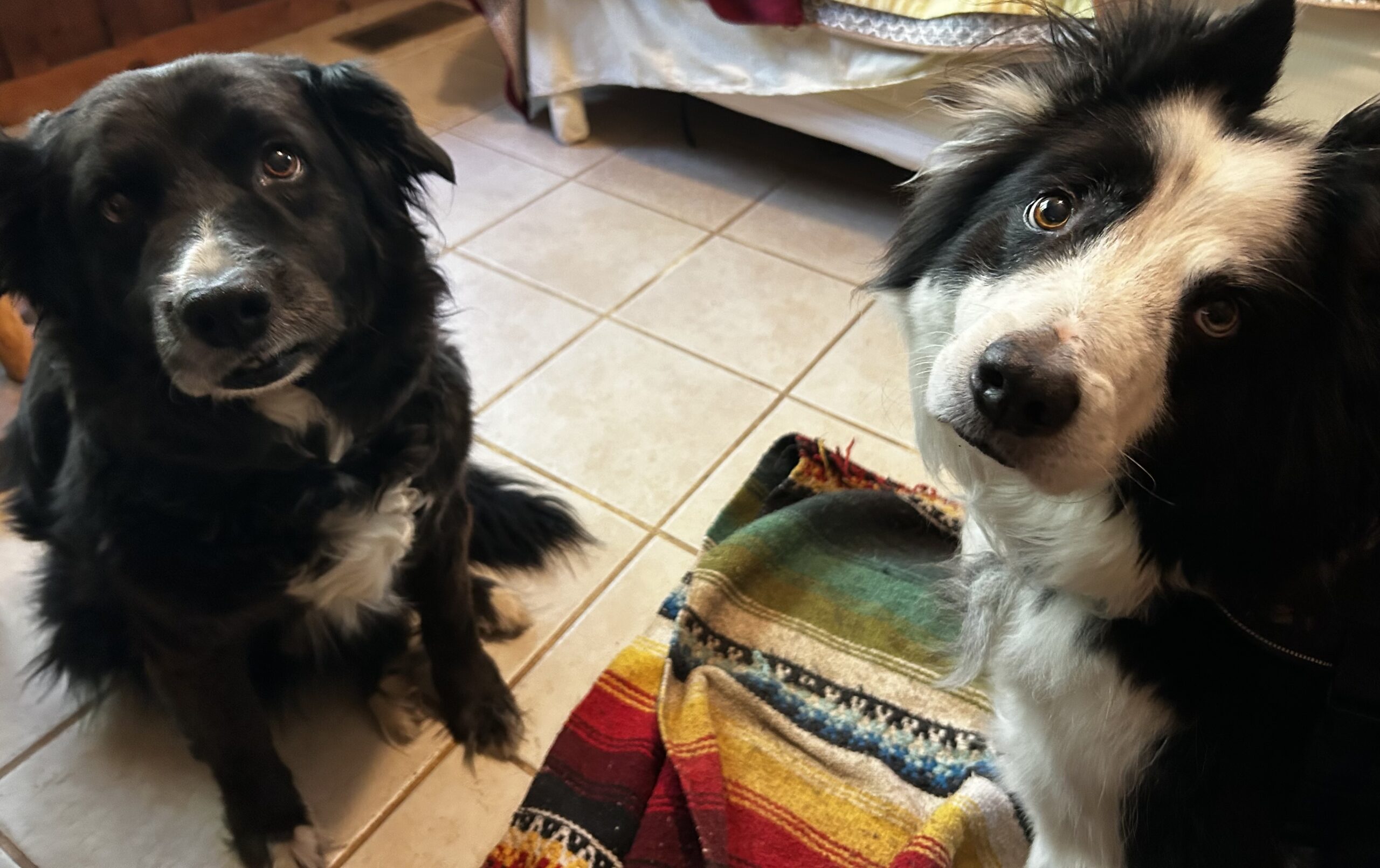
Phoebe, left, and Poe look me over and wonder if he can be trusted, this strange man who has taken them into his home. Will we be fed, and loved? Will we be sheltered from life’s storms? Who is this man anyway? Why are we here? (Click the image for an expanded view)
And, fight it or not, there are times when the brakes don’t hold. The cars jump their couplings and somersault ahead, tumbling over the engine in a great squeal of rending metal and the futile cries of our despair.
We’re never prepared.
We’ve always known it was coming. True, we’ve never known the day, the hour, let alone the minute the call would come. But we’ve know it was coming.
And come it does, just as we knew it would, catching us unawares and unready, off balance and out of sorts. Every damn time.
And I know that Phoebe and Poe are out of sorts as well. Loved ones — be they four-legged or two — always are at times like these.
We believe we can never know exactly how dogs feel, can never know exactly what they must be thinking, but we should not find that strange. It’s the same with other people. We can never really stand in their shoes either.
The best we can do, I guess, is practice empathy and extend grace — four legs or two.
And that’s what we’re trying now. And on Day 2 it’s going about as badly or as well as you might expect: In other words, we are making it up as we go.
At least Phoebe and Poe are easy going and wise in the way 12-year-old dogs can be, and wisdom certainly doesn’t hurt if you’re baking a dish without a recipe — as we are doing.
Stone cabins were less common than log buildings in early Appalachian life, but families made do with what was readily at hand — and there was no shortage of rock.
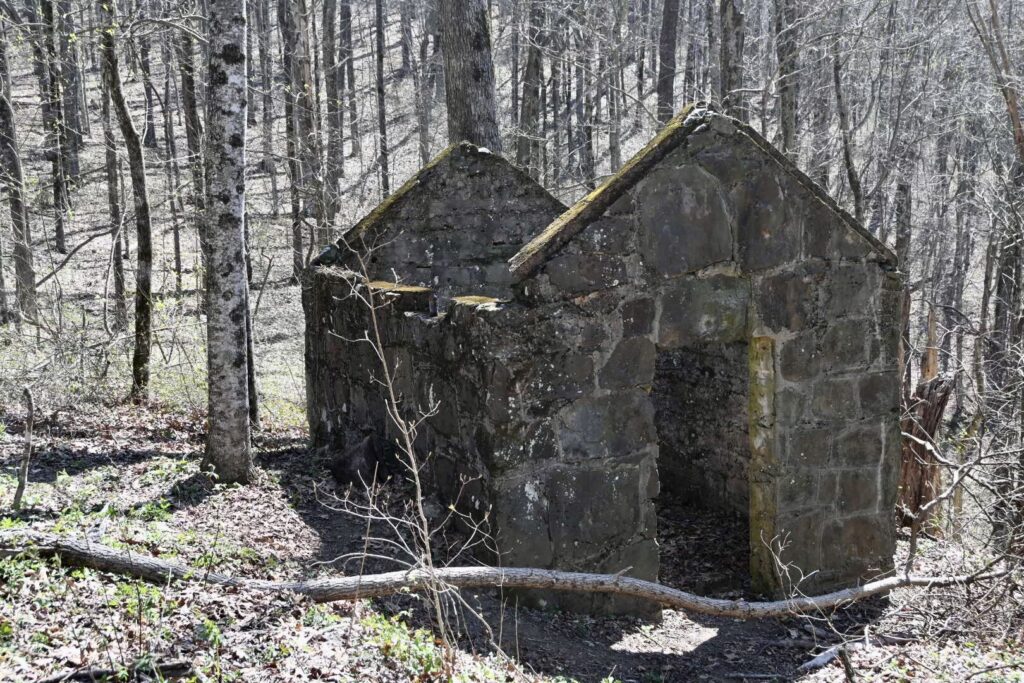
So I wasn’t surprised when I discovered the remains of a stone cabin in the woods off the road leading to the mountain-top radio towers off Tatham Gap Road. The cabin was about a mile from the fork where the road splits on its route from Andrews, North Carolina, to Robbinsville.
It offered a near perfect example of how families lived in these mountains in the late 1700- and early 1800s.
The remains of the rock cabin and outhouse along Radio-Tower Road are typical of homes from that era.
Remains of a mountain home in the Tatham Gap area of Cherokee County.
They can seem almost impossibly small to us now. It’s a windowless structure, roughly 16 feet by 20 feet — perhaps a bit smaller — but enough back in those days to shelter a full family.
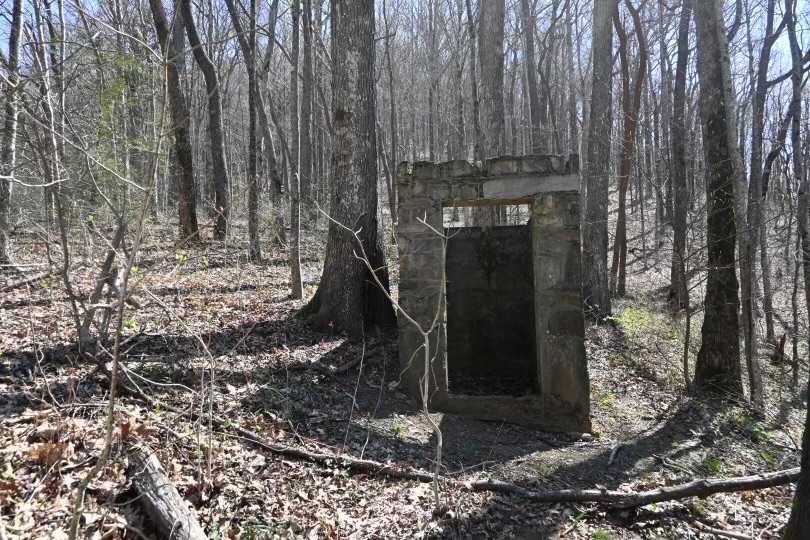
The outhouse or privy sits about 100 feet away, and also is made of stone. The nearest neighbor was likely miles away.
The outhouse for the rock cabin off Tatham Gap Road.
The cabins were known as “pens” for their windowless, solid wall designs. They had a single door and a large fireplace for cooking and heat. The emphasis during construction was on speed of building, and function and durability over comfort.
They were built to last and survive harsh winters and mountain storms. Apart from the roof, this one has survived some 200 years of mountain winters and summers.
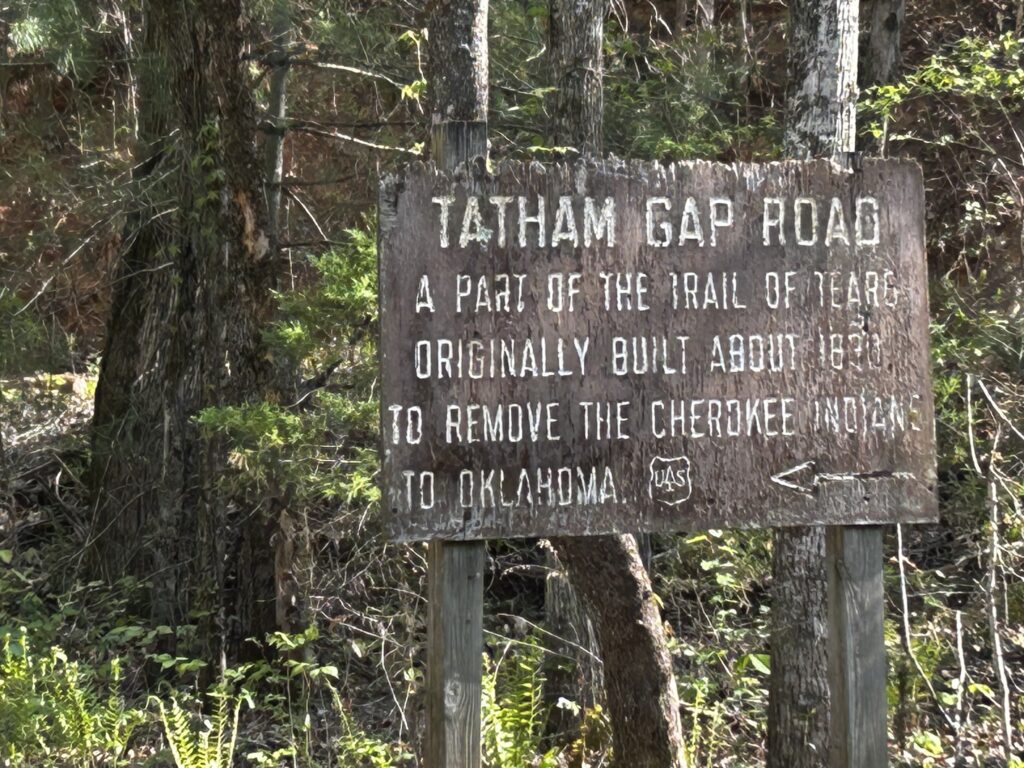
Old Forest Service sign at the foot of Tatham Gap Road, the “Old Army Road” through the mountains.
Birds called from the woods, and I put my hand on Hazel’s head to calm her while I squatted on the edge of the ravine and listened. Apart from the birds, the only other sound was the wind breathing through the trees and moving the first green shoots of spring.
All else was quiet atop the mountain.
Hazel and I were alone except for the ghosts of the long dead Cherokee that must haunt these peaks on Tatham Gap Road, or Forest Service Road 423, a section of the 5,000-mile long Trail of Tears that marks one of the early but ongoing efforts by our country to get rid of our non-white residents — to kidnap, imprison, kill or oust them and claim this world of vast spaces for our own, more white, more European kind.
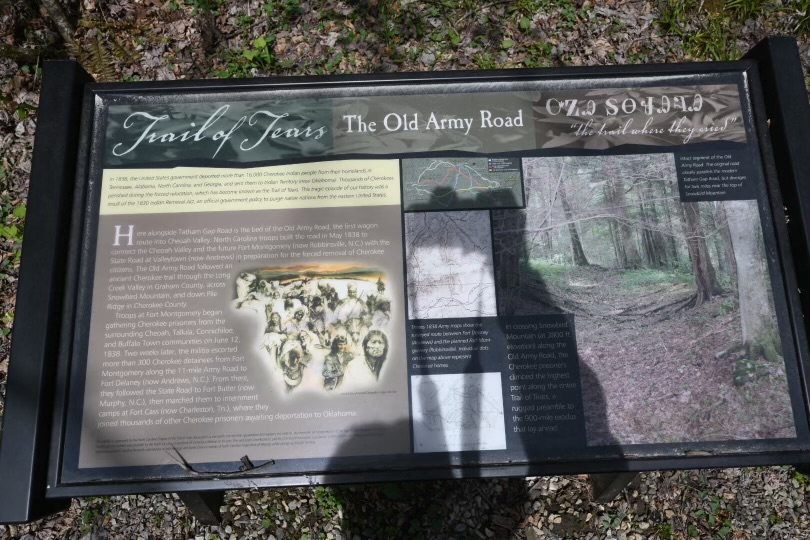
A weathered information station tells the story of the Cherokee and the Trail of Tears. The station is located near 3,800-foot-high Snowbird Mountain, the highest point along the rugged trail.
It is, as I say, an ongoing campaign — this relentless effort to rid ourselves of the other.
And 143 years ago, these woods would have been alive with the cries and tears of the Cherokee, who were corralled in their home valleys and force-marched to more barren lands, less desirable lands in the northeastern corner of Oklahoma.
When it came time to kidnap and imprison the Cherokee, the U.S. Army cleared and widened an ancient Native American path from the Cheoah Valley in Graham County, North Carolina, through Long Creek Valley and over Snowbird Mountain until they reached Pile Ridge in Cherokee County where they would hold the prisoners until they could be driven like cattle to the Oklahoma Territory.
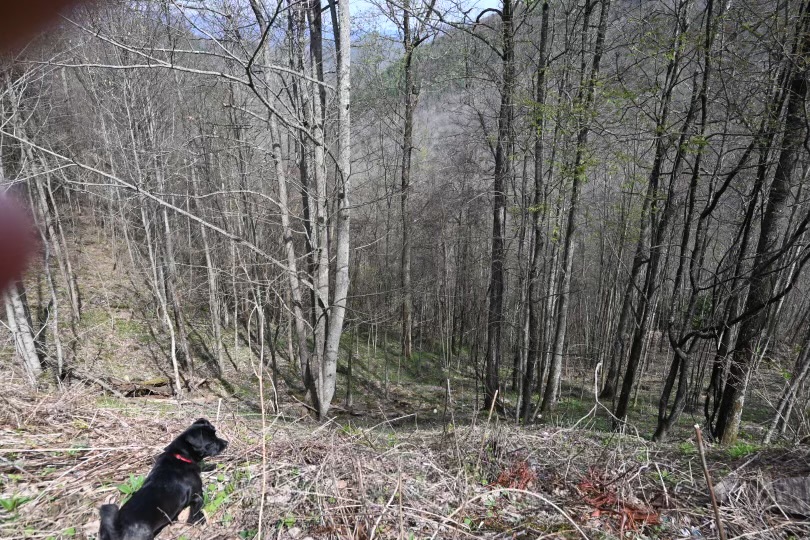
The terrain along the trail is steep and unforgiving. It was much rougher in the 1830s when the U.S. Army herded Cherokee over the mountains like cattle. Hazel takes a cautious look down the mountainside.
Some 17,000 were forced from their homes in North Carolina and surrounding states, with more than 4,000 of them dying along the way. The old, the young and the feeble were first to go, and then many of the healthy — all ravaged by cold, rain, heat or snow, and weakened by shock, abuse, mistreatment, indifference and hunger.
It was as American as America today where masked and heavily armed troops have been sicced by a vile federal administration on “alien” immigrants in communities from Minneapolis, Minnesota, to New Iberia, Louisiana, from California to Connecticut.
Like the Cherokee of old, the new unwanted are being housed in pop-up prisons designed for cruelty and callousness, managed by private, for-profit Gestapos — the CEO Group, CoreCivic and others that are running these charnel houses of capitalist evil — the Adams County Correctional Center in Mississippi, the Adelanto ICE Processing Center in California, the Stewart Detention Center in Georgia, the Karnes County Detention Center in Texas, the South Florida Detention Center, known as “Alligator Alcatraz,” in the cypress swamps of south Florida, and others.
It’s almost as if is 1838 all over again.
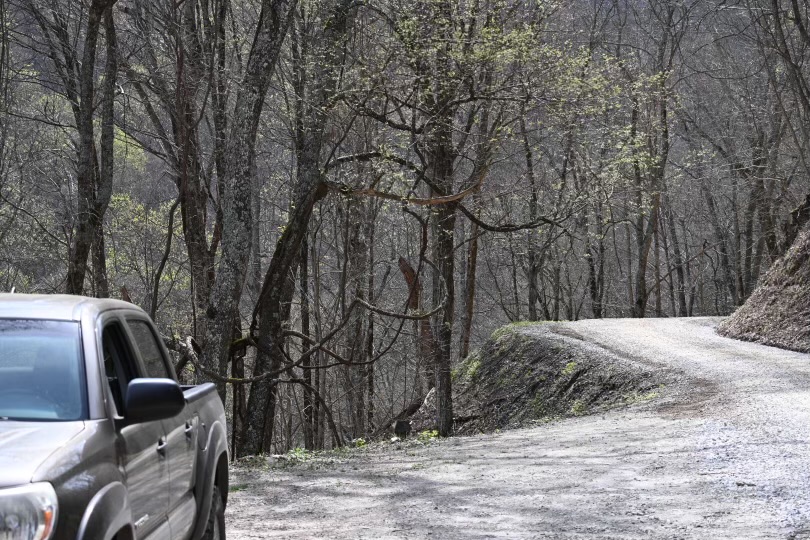
The U.S. Forest Service was working this week on the gravel road over the mountains. The steep and rugged road runs about 8 miles from Andrews to Robbinsville.
It’s older than America, of course, and probably is as old as our species. Riots broke out in London in 1517 as anger over immigrant workers boiled over, eventually making their way into a play credited to William Shakespeare.
This speech from the play is delivered to the angry crowd by London Sheriff Thomas More. He asks the rioters to imagine that they themselves are the immigrants being attacked:
Grant them removed, and grant that this your noise Hath chid down all the majesty of England; Imagine that you see the wretched strangers, Their babies at their backs and their poor luggage, Plodding to the ports and coasts for transportation, And that you sit as kings in your desires, Authority quite silent by your brawl, And you in ruff of your opinions clothed; What had you got? I’ll tell you: you had taught How insolence and strong hand should prevail, How order should be quelled; and by this pattern Not one of you should live an agèd man, For other ruffians, as their fancies wrought, With self same hand, self reasons, and self right, Would shark on you, and men like ravenous fishes Would feed on one another.”
A few Cherokee, of course, didn’t make the trip at all. They hid out in the mountains along the Trail of Tears and avoided the interloping new-comers for years, rebuilding their society and lives day by day until they reassembled the rudiments of a nation.
Today the Eastern Band of Cherokee Indians in North Carolina controls approximately 57,000 acres of land, primarily the Qualla Boundary near the Great Smoky Mountains National Park.
But the stink of what we did as a nation has endured and will endure long after the deaths of all of us complaining about the hoards of immigrants supposedly taking our jobs, raping our daughters and buying up all the homes in our lands.
Eating our pets, I hear.
How easily we forget our history. How easily we neglect to live by the precepts taught us as children. How easily we sell our souls.
Five New York newspapers gave birth to The Associated Press in 1846 when they pooled their resources to share the cost of reporting on the Mexican-American War.
And for the 180 years since then, the wire service has served newspapers all over the world.
No more, at least not as a core part of its business.
Today it announced buyout offers it has made to more than 100 of its journalists and said it is pivoting away from newspapers and shifting to visual reports, and will be trying to develop new revenue sources through companies investing in artificial intelligence.
It’s a bow to the realities of today’s media landscape. Newspapers now make up just 10 percent of the AP’s income.
But even in today’s news world, the announcement is something of a stunner: Journalists of my generation grew up on the AP, where the click, clatter and chiming “ding” of an Associated Press teletype was the background hum of our newsrooms.
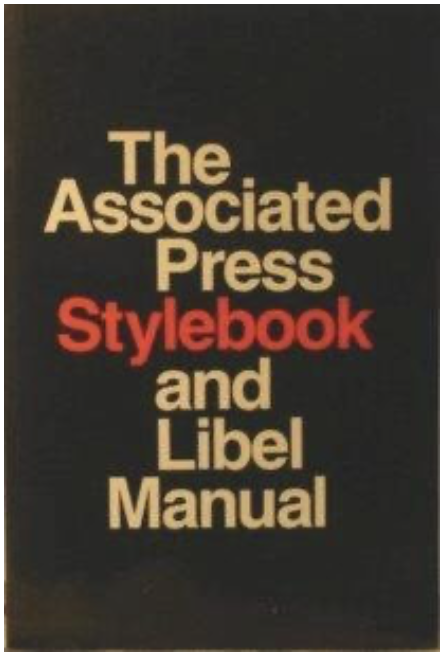
“The Associated Press Stylebook and Libel Manual” was one of the first things an aspiring newspaperman bought — usually with his first paycheck if he or she didn’t already own a copy.
“We’re not a newspaper company and we haven’t been for quite some time,” Julie Pace, executive editor and senior vice president of the AP, told the AP’s own David Bauder.
Gannett and McClatchy, two of the U.S.’s largest newspaper companies, stopped publishing AP wire content in 2024, contributing to a 25 percent decline in The Associated Press’ newspaper revenue in the past four years.
According to Bauder’s article, the AP had also learned that Lee Enterprises, yet another large newspaper publisher and AP client, was looking for a way out of a contract that is set to expire at the end of this year.
Pace told Bauder that whether or not the company conducts layoffs will depend on how many people take the buyout.
Still, Pace said, “The AP is not in trouble…We’re making these changes from a position of strength but we’re doing so now to recognize our changing customer base.”
The AP will be upping its video teams, as well as adding journalists to beats “on topics of known customer interest.” It will also still have journalists in all 50 states.
Lately, the AP has been looking to tech companies for revenue (and says its revenue from such deals has grown by 200 percent over the last four years. It’s made deals with Google and OpenAI, and in March announced a deal to provide election data to the prediction market Kalshi. Elections in particular are a big money-maker for the AP; last year ABC, CBS, NBC, and CNN all signed up for its service providing election data.
The AP News Guild, the union representing AP staff, has said 120 people were offered buyouts. The union also said that the AP ignored a union request to bargain over artificial intelligence.
“AP continues to get rid of experienced staff and flirt with artificial intelligence” the union said in its statement, “ignoring the opportunity to differentiate AP stories as ones that are and always will be created by human journalists,” the Guild said.
“Tuesday will be Power Plant Day, and Bridge Day, all wrapped up in one, in Iran. There will be nothing like it!!! Open the Fuckin’ Strait, you crazy bastards, or you’ll be living in Hell – JUST WATCH! Praise be to Allah. President DONALD J. TRUMP.”
Thus spoke U.S. President Donald Trump on his Truth Social social media on Easter Sunday.
You don’t even need to let that sink in. It will of its own accord: Easter Sunday.
So, yes, it really has come to this: Our nation’s foreign affairs are being conducted by the equivalent of inebriated Uncle Rufus from his seat at the American Legion bar outside Toad Suck, Arkansas.
What a crazy old bastard.
What’s especially unnerving and odious is that my generation elected this potty-mouthed ignoramus, serial liar, draft-dodger, narcissist, convicted rapist, and an overseer of six bankrupt businesses. Six.
And not once have we elected him, but twice — to the highest office in the land.
It should be clear to everyone by now that my generation has woefully failed in its civic duties, and a depressingly large percentage of my group is either too dumb, too deluded, too self-centered or too altogether out of touch to have an inkling of the damage they have done to themselves, their children, their grandchildren and the nation.
We’ve screwed up.
And the thing is, as far as I know, there’s still no rehab for stupidity.
We gotta live with this shit and I’ve no clue how to do it. So I hope you haven’t come here looking for advice. I got nothing but despair.
But even I know that despair is a loser’s game.
“No society can expect its children to engage with a world they think has already given up on them.”
Robert Pondiscio, a former public school teacher who is now at the American Enterprise Institute, made that remark several months back while urging teachers to avoid adopting “an unbearable bleakness” in their classrooms.
Optimism, he argued, is an essential civic virtue.
Yet optimism is something in this day and age that seems to be its own category of rare earth mineral, but it’s out there, and it must be dug from the soil and championed.
Perhaps the only streak of optimism to be found in Trump’s disgraceful Easter Sunday post is that it opens yet another window to his soul that should make it easy to see through for all but the most deranged of his supporters: This is a man off his meds and off his rocker.
This is a man woefully unfit to lead, a man so morally and mentally stunted that questions about his sanity are not only apt they are essential.
Wherever you are on this spectrum of certainty and doubt, it’s okay to start small.
Let’s not join our old high school friends in re-posting ICE-friendly AI smut films; let’s not lean into that pot-like buzz of indulging in quick anger on our social media feeds.
When they go low, we go high really wasn’t bad advice. The air is cleaner and clearer above the clouds.
The view is better, different. It’s true, of course, that our technologies have made it easier for so many of us to see so much more of the world, but never before have so many of us seen so much without understanding what we are seeing.
Take time to understand the world. At the very least, take time to try.
Time may well be running out for there’s no dodging the fact that the USA has become a rouge nation where war crimes and the delight of bombing another nation “back to the stone age” are dangerously close to being normalized.