Perfect is the Enemy of the Good

My newish Guardian 5.5 came with an okay taco-style leather sheath, but I guessed before ordering the knife that the scabbard would’t do justice to the fine blade from the Washington state maker.

I was right. So I made my own.
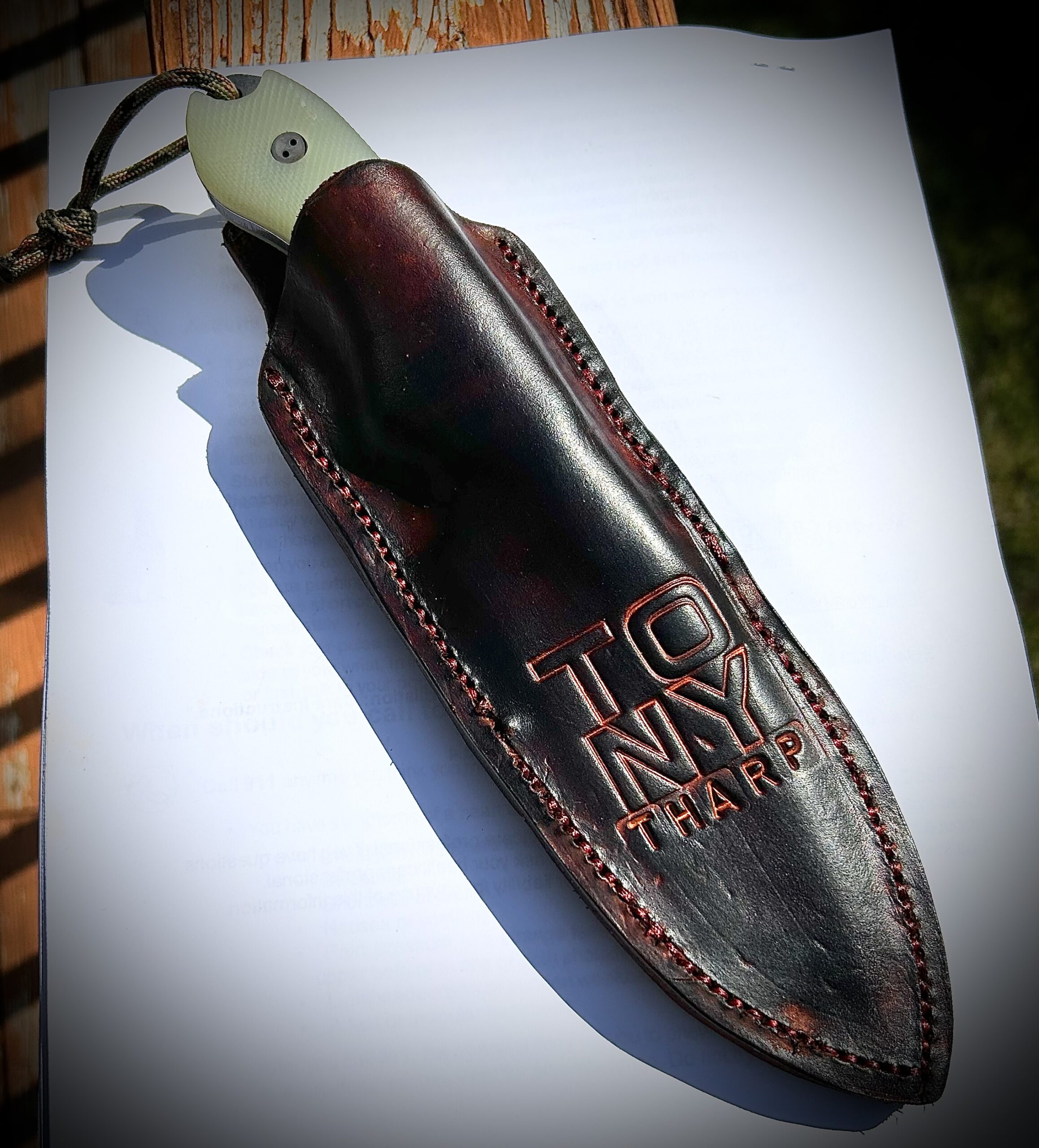
One of the early sheaths I made in a dark brown finish that I’m not especially crazy about, but I had the dye on hand. You should be able to click on the image for an expanded view.

The three sheaths I’ve made have been an improvement over the scabbard that came with the knife, I suppose, but beyond that about the best I can say for them is that they will do for now. Building them also taught me that, with more care, I will likely be able to make one I’m actually proud of.

The sheath that arrived with the knife from Bradford Knives was a “taco-style” leather sheath — a basic, fundamental one in thin and unappealling leather.

I’m not a fan of the taco style, made by folding a piece of leather over itself to fit the knife and then sewing it closed on only one side. There’s nothing wrong with a taco, and there are plenty of useful and beautiful ones around. It’s strictly a matter of what appeals to the eye.

And to my eye, the one from Bradford wasn’t one of the beautiful ones.

In making my own, I started with an 8-9 ounce vegetable tanned half-shoulder from Weaver Leather Supply, along with a few leather tools from the same company.

I wanted a pancake style sheath, which is one sewn on both sides of the knife, and thus requires melding two pieces of leather rather than simply folding it as is done in the taco style.

The half-shoulder is a big piece of leather, roughly 4 feet by 4 feet, plenty for a few tries at a knife sheath with more than enough left over for some collars for the three pups.

I made one false start. The sheath in the photo above was my second try, and the only one at that point that I went all the way with — shaping, sewing, and dyeing it.

By the way, if you know the expression that I used as the title for this piece, you can thank Shakespeare, who wrote in his “King Lear” in about 1606, “Striving to better, oft we mar what’s well” enough.
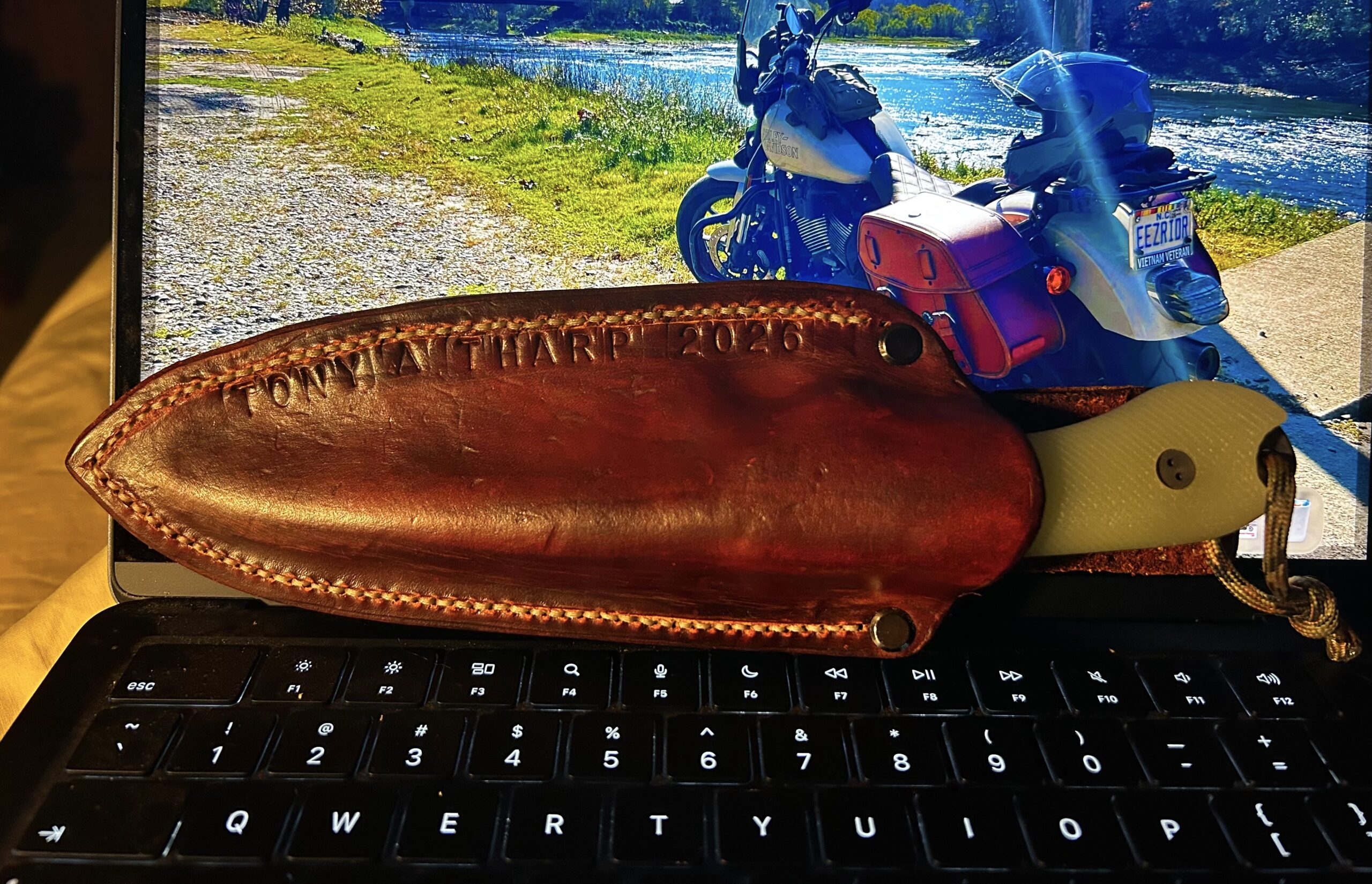
A later sheath that still shows lots of imperfections and stupid mistakes. I believe this finish is called British Tan. So far, this is a favorite. I hope I can do better. Again, you should be able to click on the image for an expanded view.

Montesquieu used the phrase, “The best is the mortal enemy of the good” in 1726, and Voltaire in 1770, borrowed an older Italian proverb, with his “Il meglio è l’inimico del bene” — The best is the enemy of the good.

Since then, the phrase has been off and running, probably even appearing in at least one episode of Beavis and Butt-Head — which, if true, almost certainly qualifies it as certified cliché.

Truth is, even without an appearance on Beavis and Butt-Head, the phrase is a cliché — worn, weathered, wrinkled and overused to the point of annoyance.

To which we plead no contest and throw ourselves on the mercy of the court.
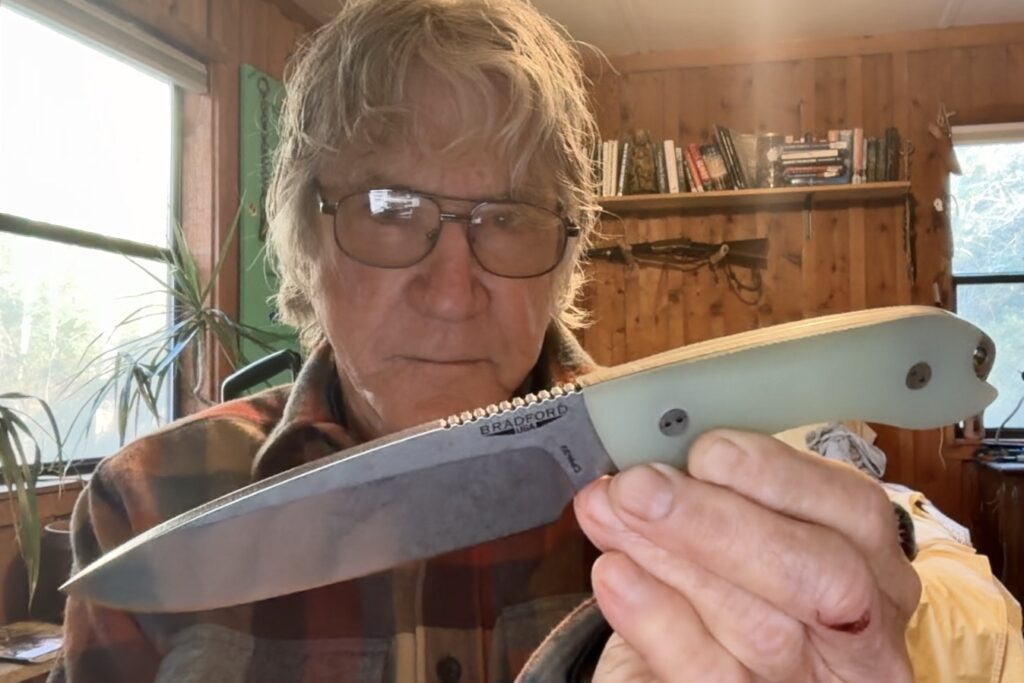
There’s little that’s as satisfying as a newly sharpened, well-made knife

The man we know today as Turkana Boy was almost certainly smiling when he picked up his new stone knife, gently rubbed his finger along the freshly flinted edge, and uttered a satisfied, “Ah, yea,” — or its equivalent in the lingo of Homo erectus.

We humans, beginning with our early ancestors, have been using knives for at least 1.5 million years, and you can be assured they were as much a joy to us back then as they are today.

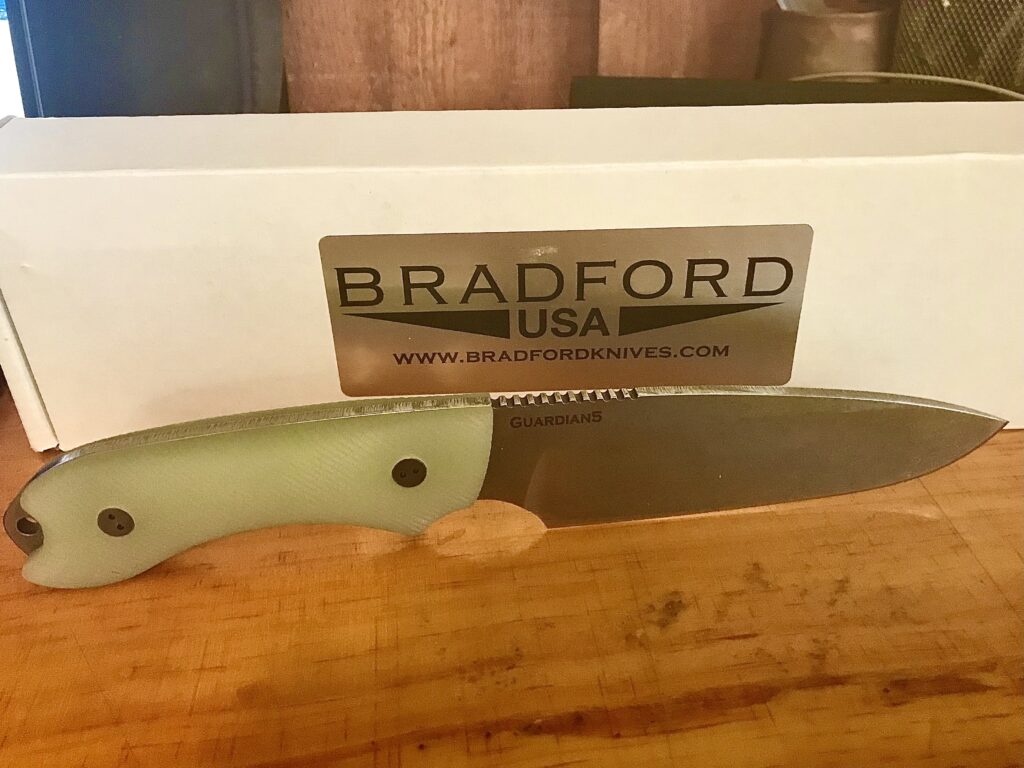
The Guardian 5 from Bradford knives.

A joy, a necessity, and all but indispensable first-tool for humankind that has never lost its intrinsic appeal.

That’s because a good knife is as useful and necessary today as it was when Turkana Boy and his family were hunting the banks of the Nariokotome River in northwest Kenya during the Early Pleistocene epoch.

To hold a sharp, well-made knife in your hands is to slip through the gates of space and time and join the caravan of pre-historic travelers setting out from their African base on an ages-long, dangerous, and uncertain journey to colonize the world.

The knife was the essential tool in making that journey possible.

Turkana Boy


While the function of a knife is the same today as it was when Turkana Boy sliced a serving of antelope from the animal roasting above his family campfire, the material they’re made from has come a ways.

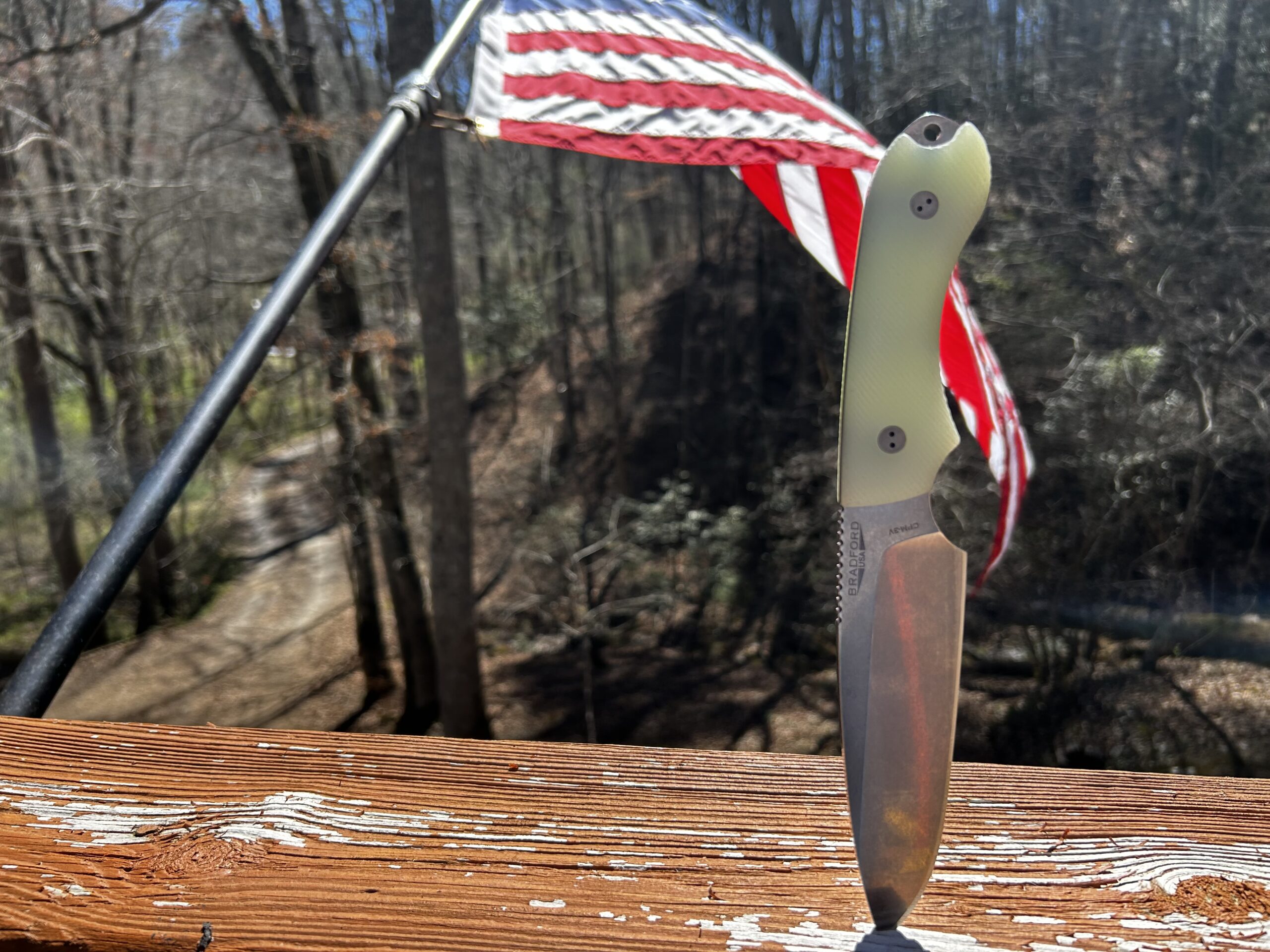
Take the Guardian 5 shown in the photo above: it’s fashioned from a high-tech steel manufactured by Crucible Industries using a sintered proprietary process known as Crucible Particle Metallurgy which — to greatly simplify the undertaking — atomizes molten alloy into fine powder that is then hot pressed into sheets that are just about ideal for making exceptionally hard and super-sharp knives.

There’s a vast difference between today’s steels and yesteryear’s D2 tool steel from which most of our old knives were made. That said, D2 still makes a better than passable knife, though short of what you get with CPM-3V, Magnacut, Elmax, Cruwear or some of the other more refined and more pure steels.

Another view of the Guardian 5 from Bradford knives.


The newer steels vastly reduce impurities and non-metallic goop that create weak points in a blade — unwanted hitchhikers such as sulfur, nitrogen, phosphorus and junk metals like tin or lead. With that detritus gone or minimized you’re left with a steel that has increased edge retention, more toughness and greater corrosion resistance.

The Guardian 5 blade, for those who may wish to know, is finished in what Bradford calls “stonewash;” the blade is ground to a sabre edge. The handle is made of G-10, a high-pressure fiberglass laminate of cloth and epoxy resin. It’s exceptionally strong, moisture-resistant and lightweight. The light green finish on the handles on my model is called “ghost.”

Bradford Guardian 5

G-10 is also low- to zero- maintenance, making it a popular choice for outdoor and heavy-use knives.

You can get the Guardian in other configurations and lengths, from a 3-inch to a 6-inch blade, I believe, along with other blade finishes and a choice of several handle finishes. All ship with a sheath — leather or nylon. Take a look at the company website.

Bradford USA is located in Kent, in Washington State. You won’t go wrong ordering your next knife from them.