
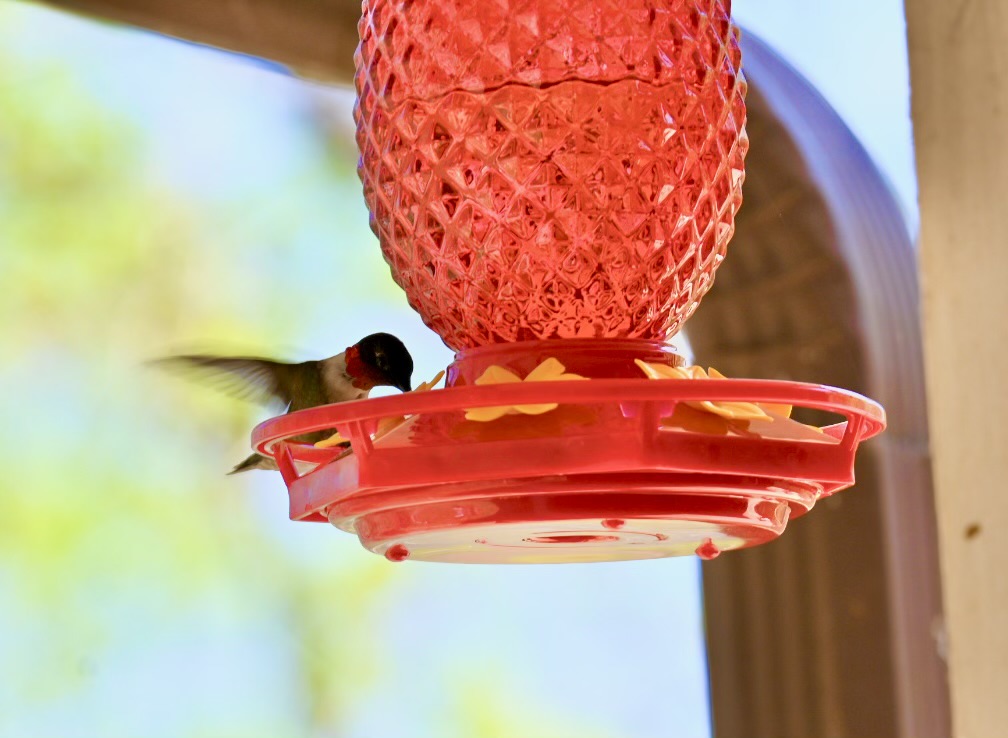
The first hummingbird of spring visited my deck on Thursday, two days ago, and today, Saturday, April 11, I finally got a photo of one.
The visitor I got a blurry photo of traveled to Cherokee County, North Carolina, from Central America. Like most of his fellow travelers, he is a ruby-throated hummingbird — the primary species we have in this part of the country.
According to researchers at North Carolina State, millions of hummingbirds make the trip back and forth from North Carolina to Central America.
The males arrive first, some as early as late March and others in early- to mid-April. The females are not far behind. The small birds are like many of our part-time residents — here for the season, where they will nest, mate and breed.
But before the weather turns too cold in the fall, they’ll head south again, many of them traveling across the Gulf of Mexico to warmer climates in Southern Mexico, Belize, or Guatemala. Some travel as far south as Panama.
By mid-October, most if not all of the tiny, colorful critters will be gone to spend the winter in the warmer south. While many travel overland through Texas and Mexico, others map a more direct route, flying straight across the Gulf of Mexico and into Central America.
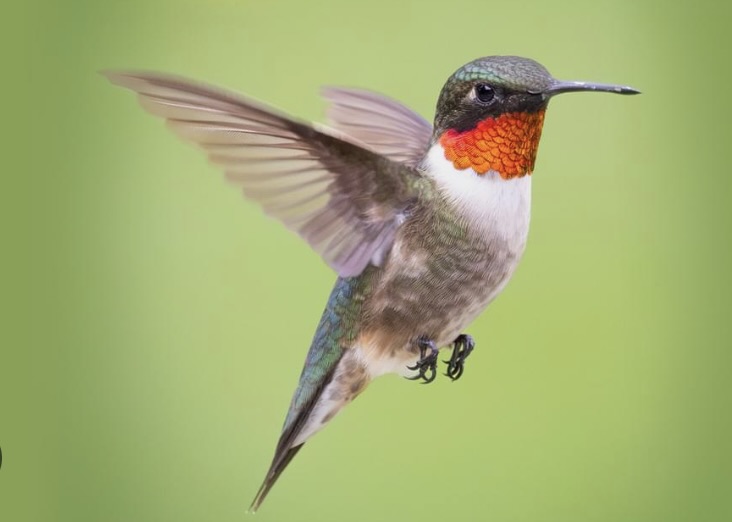
To beef-up for the 1,500- to 2,000-mile trip, hummingbirds will gain roughly from 25 percent to 50 percent of their regular weight — and occasionally up to 100 percent — from 3 grams to 6 grams.
Even so, estimates are that nearly half the migrating population may not survive the trip. And for some species, the trip is much longer than 2,000 miles. Rufous hummingbirds, for example, migrate from their winter habitats in Western Mexico and follow the Pacific flyway north into California and then on to Alaska where they nest and breed over the summer.
Those who survive make it to Alaska by May, and by July have had their families, and are heading south again to take advantage of late blooming alpine flowers.
Migration isn’t the only danger these tiny specialized nectarivores. Some species have lost half their numbers to pesticide use and other environmental degredations of the modern era. But they also are highly adaptable.
There are now more than 330 recognized hummingbird species, but UC Berkeley herpetologist Jimmy McGuire believes that number could double in the next several million years. “We are not close to being at the maximum number of hummingbird species,” McGuire says.